




 |
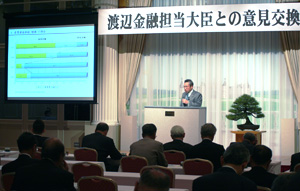 |
Minister Watanabe delivered a keynote speech at a Dialogue Meeting with SME Managers in Tottori (May 19) |
|
Photograph Gallery
In this corner, we post photographs of the Minister, the Senior Vice Minister, the Parliamentary Secretary and FSA officials at work in meetings, conferences and other events.
 |
|
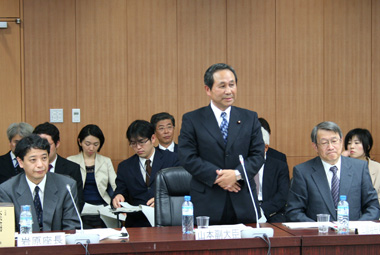
The Senior Vice Minister Yamanoto made an address at the first working groupe of settlement of finacial council (May 16)
|
[Featured]
Outline of Dialogue Meeting Between Minister for Financial Services Watanabe and SME Managers, etc. (in Tottori)
On May 19, 2008, the Financial Services Agency (FSA) and the Chugoku Finance Bureau of the Ministry of Finance held a dialogue meeting in Tottori City, Tottori Prefecture, between Minister for Financial Services Yoshimi Watanabe and managers of small and medium-size enterprises (SMEs) and representatives of financial institutions in the region. The objective of this meeting was to listen to the voice of the local community and reflect it in financial regulation and supervision going forward.
The meeting was held upon the Prime Minister's instruction to the effect that the conduct of politics and public administration should be reviewed comprehensively so as to change the mindset of government in a way that ensures that public administration reflects the standpoint of consumers and ordinary people. It provided an opportunity for dialogue with both the providers and users of financial services in local communities in order to canvass the viewpoints of the people actually doing business and reflect them in financial regulation and supervision. The FSA, together with the Kanto Finance Bureau, held a similar dialogue meeting in the Tsubame-Sanjo region of Niigata Prefecture on January 16, 2008.
«Program»
- Keynote Speech by Minister for Financial Services Yoshimi Watanabe
- Dialogue Session between Minister Watanabe and participants
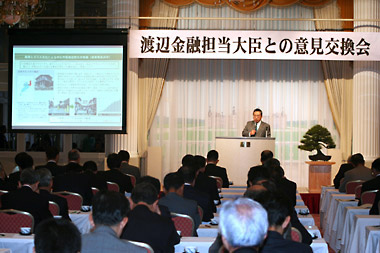
1. Key Points of Keynote Speech by Minister Watanabe
- Recent Financial and Economic Developments
- In terms of GDP (gross domestic product), the size of the Japanese economy is 4.4 trillion dollars and that of the U.S. economy is three times as large as this. The Chinese economy is growing very rapidly, although the recent great earthquake caused huge damage to China, and is likely to overtake the Japanese economy within five years if it maintains a similar pace of growth after recovering from the earthquake damage.
- Among the OECD member countries, Japan ranked second in terms of per-capita nominal GDP in 1993 but has now dropped to 18th. The total amount of global financial assets expanded about four-fold between 1990 and 2006. Unfortunately, Japan's financial assets only doubled or so.
- The greatest cause of the expansion of global financial assets is the so-called monetization of shares. Since the collapse of the Berlin Wall, economies around the world have been integrated, and shares have come to substitute the role of money, leading to a rapid expansion of financial assets. The competition for foods and resources is heating up against the background of the expansion of financial assets.
- Also behind this competition is the subprime mortgage problem. This problem emerged around July last year, when Moody's downgraded the ratings of subprime-related securities. In August, the "Paribas shock" occurred, triggering a stock price plunge. Since around that time, the prices of commodities, such as soybeans and wheat, started to rise. Although the prices have declined recently, they are still at fairly high levels.
- Foreigners account for 60-70% of transactions made on Japanese securities exchanges, which means that a large number of people look at prices in dollar terms. If looked at in dollar terms, the Nikkei Average and the New York Dow have shown similar movements. Although it is said that Japanese stock prices have fallen most sharply on a local-currency basis, there is little difference in the rate of decline in dollar terms.
- Of the total amount of financial assets held by households In Japan, worth 1,500 trillion yen, cash and deposits account for half, or 750 trillion yen. There is no other country where the proportion of cash and deposits is so large.
- A look at corporate balance sheets shows that the size of Japanese companies' liabilities is larger than the size of their capital. Among developed countries based on the capitalist system, there is no other country where the size of capital is smaller than the size of liabilities. A balance sheet like this has resistance to inflation but is vulnerable to deflation. Since the collapse of the Berlin Wall, funds have flown out of Japan to other countries, leading to an asset deflation as represented by stock and real estate price declines. Behind Japan's vulnerability to deflation was the structural balance sheet problem.
- Let us look back at the history of industrial financing in Japan. In 1931, direct finance was the principal fund-raising means as shares and corporate bonds accounted for nearly 90% of the country's industrial fund-raising. Even in 1941, by which time the war-time regime of centralized power had been established, the ratio of direct finance remained high. However, in 1951, after the war ended, indirect finance accounted for as much as nearly 90%.
- Matters Related to Financial Instruments and Exchange Act
- In the Diet, deliberations are ongoing regarding the (revision of the) Financial Instruments and Exchange Act, which was put into force on September 30 last year. Since the start of the new regulatory framework, some financial institutions have become overly restrictive in sales of investment trusts, for example, as they have not yet fully adapted themselves to it. We are engaging in various public relations activities aimed at resolving misunderstandings related to this act.
- Through the revision of the act, we intend to implement measures such as: diversification of ETFs (exchange-traded funds), developing markets for professional investors, review of the firewall regulations among the banking, securities and insurance businesses and deregulation concerning Islamic finance, emissions trading and restrictions on stockholding for corporate revitalization by financial institutions.
- Current State of Regional Economies
- Regarding regional economies, local industries such as agriculture, tourism, construction and retailing have been squeezed severely. The reason why Japanese regions have been stuck in prolonged deflation is that they have been unable to resolve the supply-demand imbalance amid intensifying global competition. As excessive supply continues, deflation persists. Therefore, the key to regional revitalization is how to resolve this imbalance.
- There are various successful cases of efforts to resolve the imbalance. Kucchan Town in Hokkaido has succeeded in attracting a number of tourists from Australia and China by promoting its powder snow. Meanwhile, Nagahama City in Shiga Prefecture has achieved success without linking up with the international community. This city launched a townscape improvement initiative using a Meiji-era building known as "Black-Wall Bank" as its basis and succeeded in turning locally-made stained-glass goods into a hugely popular souvenir item. More than two million tourists visit this city annually. We are also beginning to see successful cases in remote islands. In the island town of Ama, in Shimane Prefecture, a local construction company has started cow farming on rented farmland and is selling the Ama brand of beef, which is tasty. As a result, the island's population has started increasing. Bungo Takada City in Oita Prefecture has launched an initiative to create streets whose appearance recalls the Showa era.
- The specialties of Tottori, which I mentioned at the beginning of my speech (sand hills, shallot, pears, etc.) represent a typical example of hidden treasures discovered. I really believe that the primary industry is a rich source of such hidden treasures.
- Regional financial institutions are also engaging in a variety of initiatives, including some quite unique, successful cases. The FSA has published a collection of successful cases of regional initiatives. The reference materials distributed to you show successful cases in Tottori Prefecture, such as Yonago Shinkin Bank's management support for a local inn and a tourism campaign for the Kaike hot spring region. I hope regional financial institutions will make active contributions through initiatives like these.
- Regarding the use of movable assets as loan collateral, cows were previously rejected as collateral but are now accepted. Also, there are cases in which an interest rate higher than 10% may be imposed on a bridge loan. In the Japanese financial sector, financing based on a "middle-risk, middle return" approach like this has rarely been adopted. Interest rates should reflect premiums commensurate with risks, and I believe that the "middle risk, middle return" financing will become active if the market mechanism works properly.
- I think that financial services offered by banks and cooperative financial institutions may include the provision of capital. The financial inspection manual has been revised so as to allow financial institutions to count long-term funds of a sufficiently capital-like nature as part of capital.
- In order to achieve regional revival, we need comprehensive approaches that would revive the entire region, such as reviving the local construction industry and the tourism industry, rather than reviving individual companies. In the Diet, the bill for the organization for regional revitalization is under deliberation.
- Also, there are household financial assets worth as much as 1,500 trillion yen in Japan. Our basic stance is that if Japan is to shift to a domestic demand-led economy, it is essential to take advantage of these assets.
2. Dialogue with Participants
The following are examples of opinions and comments expressed by participants in the question-and-answer session that followed the keynote speech.
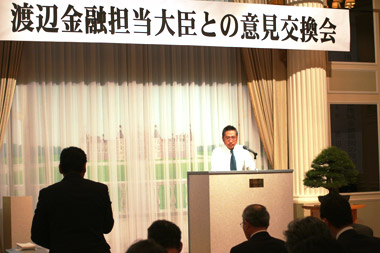
[Company Managers]
- In some cases, the strict screening by financial institutions prevents fund-raising by SMEs.
- There is no organization that can be contacted for consultations about corporate rehabilitation.
- It is necessary to establish an organization that undertakes the management of financial affairs on behalf of SMEs.
[Representatives of Financial Institutions]
- How should private-sector financial institutions handle their relations with government-affiliated financial institutions set for privatization?
* For details, please go to the FSA's Website and access "Press Conference by Minister for Financial Services Yoshimi Watanabe after a Consultative Meeting with Regional Business Managers, etc. (May 19, 2008) in the "Press Conferences" section.
Since last summer, the Financial Services Agency (FSA) has been engaging in an initiative toward improvement in the quality of financial regulation, or "better regulation." The initiative centers on the following four pillars:
Four Pillars of "Better Regulation"
- Optimal combination of rules-based and principles-based supervisory approaches
- Timely recognition of priority issues and effective response
- Encouraging voluntary efforts by financial institutions and placing greater emphasis on designing proper incentives
- Improving the transparency and predictability of regulatory actions
Under these four pillars, the FSA has been implementing measures in the following five areas of focus:
Five Areas of Immediate Focus
- Enhancing dialogue with financial institutions
- Disseminating information more widely and effectively
- Strengthening cooperation with foreign authorities
- Enhancing research functions so as to better understand market developments
- Strengthening human resource development within the FSA
On May 19, the FSA published a report on the progress made with regard to the FSA's efforts toward "better regulation" in the period between July 2007 and April 2008.
We expect that it will take time before the concept of better regulation takes root and produces results. Therefore, we will make constant efforts on a sustained basis and check the progress periodically.
Accordingly, the FSA plans to publish a report on the progress in the initiative every six month
The latest report describes the progress in the implementation of measures related to the aforementioned four pillars and five areas of focus, including the following measures.
We believe that this agreement will play a very important role in efforts to promote the optimal combination of the rules-based and principles-based supervisory approaches
* Response to the subprime mortgage problem
This is a policy challenge concerning which we must promptly identify priority tasks and implement effective measures. Based on the recognition of the depth and breadth of the problem, we have grasped and analyzed its impact on Japan's financial system and allocated administrative resources intensively to such activities as a careful examination of Japanese financial institutions' risk management. In dealing with the subprime mortgage problem, we are confident that we have made progress in efforts to strengthen our cooperation with foreign authorities, keep track of market developments accurately and enhance our dissemination of information.
In compiling this report, we conducted an anonymous questionnaire survey with the entities subject to supervision by the FSA, including banks, insurance companies, securities companies, exchanges and audit firms. We have decided to publish the survey results for reference.
The survey was conducted with regard to the following matters:
(i) Improving the transparency and predictability of regulatory actions
(ii) Enhancing dialogue with financial institutions
(iii) Enhancing dissemination of information
For this survey, we collected replies from three different classes of personnel within each institution (presidents and other top managers, directors and executives with similar ranks and section chief-class officials), rather than collecting replies on a company-by-company basis. Replies were collected from a total of 1,500 personnel.
The key points of the survey results are as follows:
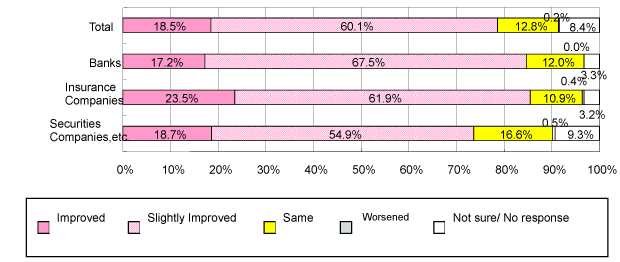
(i) Nearly 80% of the respondents perceived "improvement" or "slight improvement" in the transparency and predictability of the FSA's regulatory activities.
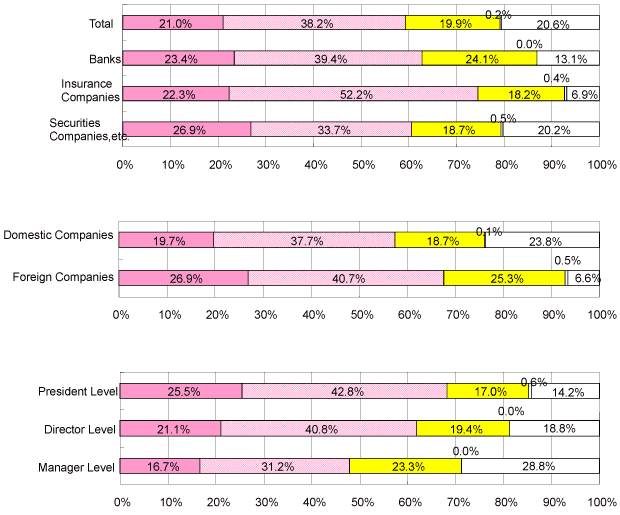
(ii) Nearly 60% of the respondents perceived "improvement" or "slight improvement" with regard to dialogue with the FSA. The ratio of foreign financial institutions that perceived improvement was higher than the ratio of domestic ones that did so. The higher the respondents' class was, the higher the improvement perception ratio was.
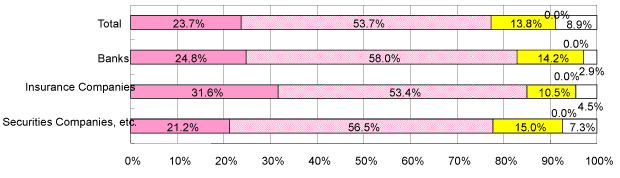
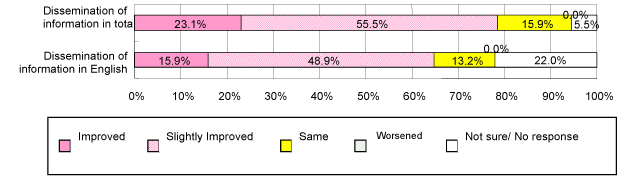
(iii) Nearly 80% of the respondents perceived "improvement" or "slight improvement" in the FSA's dissemination of information. Of the foreign financial institutions surveyed, more than 60% perceived "improvement" or "slight improvement" in the dissemination of English-language information.
FSA's English dissemination of information
We believe that the survey results indicate that reasonable progress has been made in the initiative to achieve better regulation.
In light of the survey results, we must tackle tasks such as (i) making all employees fully acquainted with the concept of better regulation, (ii) enhancing working-level dialogue and (iii) expanding opportunities for disseminating information by increasing the frequency of briefings and other events.
We intend to make constant efforts toward better regulation, such as continuously reforming the mindset of employees, including the staff of Local Finance Bureaus.
* For details, please go to the FSA's Website and access "FSA publishes the first progress report on its efforts toward "better regulation"" (May 19, 2008) in the Press Releases Section.
[TOPICS]
As global market competition intensifies, it is an urgent task for us to strengthen the competitiveness of Japan's financial and capital markets, whose international presence has been declining, and make them more attractive for investors. If the markets become more attractive, it is expected to contribute to the sustainable growth of the Japanese economy by enabling the Japanese financial services industry to produce high value added.
If we look at the state of Japan's financial and capital markets, it is evident that many Japanese financial institutions lag behind foreign rivals in the provision of sophisticated financial products and services. Moreover, as the confusion that followed the enforcement of the Financial Instruments and Exchange Act shows, a sense of compliance is not thoroughly shared among the financial supervisory authorities, financial institutions and industrial companies.
In light of this, expanding the pool of talent with financial knowledge and skills befitting an international financial center and ensuring a shared sense of compliance among personnel engaged in regulation and in business is one of the most important tasks that Japan must achieve in order to strengthen the competitiveness of the financial and capital markets. Therefore, the regulatory authorities and market players and operators need to work together in this regard.
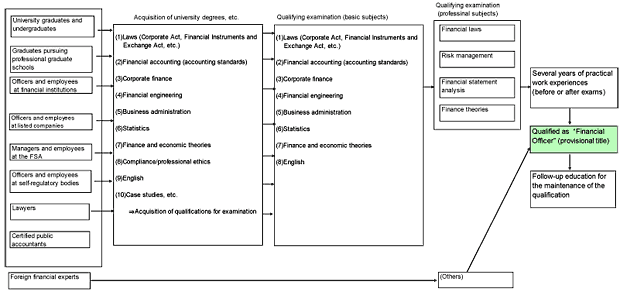
From this viewpoint, the FSA's Financial Research and Training Center (Director: Naoyuki Yoshino, Professor, Keio University) established a study group on financial experts (hereinafter referred to as the "Study Group") in November 2007, which has so far held five sessions of vigorous discussion.
The Study Group first discussed elements of the basic concept of "financial experts" as referred to in its study, such as the role to be played by the experts, the image of their career path and their necessary traits. Then, their discussions moved on to issues such as the required qualifications and practical work experiences as well as follow-up education, and global qualification recognition. (For details of the past discussions, please click here [Link to http://www.fsa.go.jp/frtc/kenkyu/kenyukai.html ].
].
The summary of issues regarding the basic concept concerning financial experts based on the past discussions was published on April 30, and we invited public comments. We will continue the study with a view to compiling the final version of the summary of issues around this summer.
Proposed Image of 'Financial Expert'
Abolition of Expiration Dates of Tax-Free Treatments of Interest Income on Offshore Accounts and Bond Transactions under Repurchase Agreements
The Act to amend the Income Tax Act and other Tax Acts (Act No. 23 of 2008) was enacted in the 169th session of the Diet on April 30, 2008, and was promulgated and enforced on the same day.
As a result, the expiration dates of the following measures were abolished to make them permanent:
(1) The tax-free treatment of interest income from deposits, etc. booked in special international financial transaction accounts (offshore accounts)
(2) The preferential tax measure (tax-free treatment) for interest income from bond transactions under repurchase agreements that are conducted by foreign financial institutions, etc.
The Tokyo offshore market was established in December 1986 in order to promote the internationalization of Japan's financial and capital markets and the internalization of the yen, and tax-free treatment was applied to interest income earned by non-residents from deposits, etc. booked in offshore accounts. Previously, this measure was up for renewal every two years.
Meanwhile, bond transactions under repurchase agreements allow the trading parties to exchange their funds and government bonds according to their needs. Under the FY 2008 Tax Reform, tax free treatment has been applied as a special measure to interest income from bond transactions under repurchase agreements that are conducted by foreign financial institutions, etc. in order to promote the ownership of government bonds. Previously, this measure was up for renewal for every two years.
Under the Plan for Strengthening the Competitiveness of Japan's Financial and Capital Markets, which was adopted on December 21, 2007, the Financial Services Agency (FSA) aims to make the markets more attractive for investors. The FSA believes that making the above measures permanent will contribute to ensuring the stability of transactions in Japan's offshore market and further bond transactions under repurchase agreements between domestic and foreign financial institutions, etc., thereby helping to strengthen the competitiveness of the country's financial and capital markets.
* For details, please go to the FSA's Website and access "Abolition of Expiration Dates of Tax-Free Treatments of Interest Income on Offshore Accounts and Bond Transactions under Repurchase Agreements" (May 18, 2008) in the "Press Releases" section.
Japan and Singapore have maintained close financial-sector relations with each other as represented by the presence of many Japanese financial institutions in Singapore and the Tokyo Stock Exchange's acquisition of an equity stake of approximately 5% in the Singapore Exchange. The Financial Services Agency has recently held the fourth meeting of the Joint Committee on Financial Services Cooperation with the Monetary Authority of Singapore (MAS)(Note).
(Outline)
(1) Date: April 23, 2008 (Wednesday)
(2) Location: Singapore
(3) Participants
From Japan:
Nobuyoshi Chihara, Deputy Commissioner for International Affairs at the FSA
From Singapore:
Teo Swee Lian, Deputy Managing Director in charge of prudential supervision at the MAS
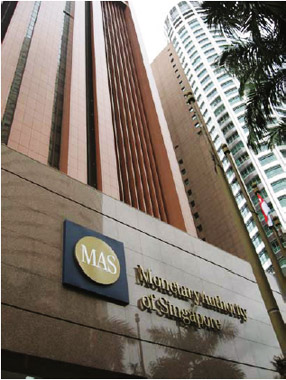
The Joint Committee on Financial Services Co-operation was established based on the Japan-Singapore Economic Agreement for a New Age Partnership, which took effect in November 2002.
The Plan for Strengthening the Competitiveness of Japan's Financial and Capital Markets, issued late last year, called for efforts to enhance cooperation with foreign authorities, in particular stressing the need to "strengthen cooperation with supervisory authorities in rapidly growing Asian markets." Accordingly, the FSA and the MAS have decided to discuss not only developments and issues related to financial-sector cooperation but a broader range of matters.
At the latest meeting, the participants, including Mr. Nobuyoshi Chihara, Deputy Commissioner for International Affairs at the FSA, and Ms. Teo Swee Lian, Deputy Managing Director in charge of Prudential Supervision at the MAS, discussed issues of mutual interest related to financial-sector and international developments, including the subprime mortgage problem and the Plan for Strengthening the Competitiveness of Japan's Financial and Capital Markets. Mr. Ong Chong Tee, Deputy Managing Director in charge of external relations, also joined the meeting, and the participants agreed to further strengthen cooperation between the two countries.
We believe that it is extremely important for the FSA to strengthen cooperation with the supervisory authorities of Asian countries as they have achieved rapid economic development, leading to closer financial-sector exchanges and cooperation and increased mutual dependence between Japan and them. We intend to continue to strengthen cooperation between Japan and Singapore through the Joint Committee on Financial Services Cooperation and other meetings and activities.
(Note)
The MAS, which combines the functions of a central bank and a financial regulatory organization, has comprehensive supervisory authority over the banking, securities and insurance businesses.
It was established in 1971 to integrate the functions related to financial and monetary administration that had until then been undertaken by various governmental departments and agencies, and the oversight of the MAS was transferred to the Prime Minister's Office in 2006.
Senior Minister Goh Chok Tong (former Prime Minister) governs the MAS as Chairman of the MAS Board, while Managing Director Heng Swee Keat is the top administrative official of the MAS.
* For details, please go to the FSA's Website and access "FSA holds the fourth meeting of the Joint Committee on Financial Services Co-operation with MAS" (April 25, 2008) in the "Press Releases" section.
Since 2005, European Union(EU) companies that raise funds in the EU region have been obligated to adopt the International Financial Reporting Standards (IFRS). The European Commission (EC), the executive branch of the EU, also intends to obligate non-EU companies that raise funds in the EU region to adopt the IFRS or equivalent standards, starting in January 2009, and has been proceeding with equivalence evaluation.
As part of the equivalence evaluation, the EC drew up a working paper concerning the equivalence of accounting standards adopted by Japan, the United States, China, Canada and South Korea and published it on April 22, 2008.
This report covers the progress made in the process of converging the standards of those countries toward the IFRS and the progress toward the elimination of reconciliation requirements (Note 1) that apply to EU companies operating in those countries. Regarding the Japanese standards, the report included the following statements.
* The EC believes that, at this stage, Japan is on track to meet the criteria for equivalence and, unless there is evidence that the ASBJ (Accounting Standards Board of Japan) will not meet the targets set out in the new convergence timetable (Note 2) on time, expects to make a proposal on that basis.
* The Japanese authorities do not require any reconciliation for EU issuers which prepare their financial statements using IFRS as adopted by the EU.
The EC has submitted this report to the European Securities Committee and the European Parliament and plans to present a draft of the final judgment concerning equivalence in due course.
The FSA has been engaging in active dialogue with the EC, including through the Japan-EU Monitoring Meeting on Developments in Accounting and Auditing Issues, in order to ensure that both Japanese and EU markets are open to the outside by maintaining mutual recognition of each other's accounting standards.
(Note 1) The United States, for example, requires non-U.S. companies listed in the United States to compile financial statements based on the U.S. standards, or to reconcile their financial statements to the U.S. standards. However, the U.S. Securities and Exchange Commission (SEC) decided in November last year to remove the reconciliation requirement for non-U.S. companies adopting the IFRS as issued by the International Accounting Standards Board (IASB).
(Note 2) In August last year, the ASBJ, which is responsible for the establishment of Japanese accounting standards, signed the "Tokyo Agreement" with the IASB, under which it will accelerate convergence between the Japanese standards and the IFRS. In December last year, the ASBJ published a timetable for the convergence based on the Tokyo Agreement.
[Explanations of Laws and Regulations]
FSA Outlines the "Cabinet Office Ordinance for Amendment of the Cabinet Office Ordinance on Disclosure of Corporate Information, etc." and other ordinances
The Financial Services Agency (FSA) invited public comments between March 12 and April 14, 2008 on the Cabinet Office Ordinance for amendment of the Cabinet Office Ordinance on Disclosure of Corporate Information, etc.
The FSA received 38 comments from seven organizations.
The details of the public comments we received and our conclusions were published on April 28 and May 30 (in Japanese). After undergoing modifications based on the comments and our conclusions, the Cabinet Office Ordinance was promulgated on May 30.
The details are as follows:
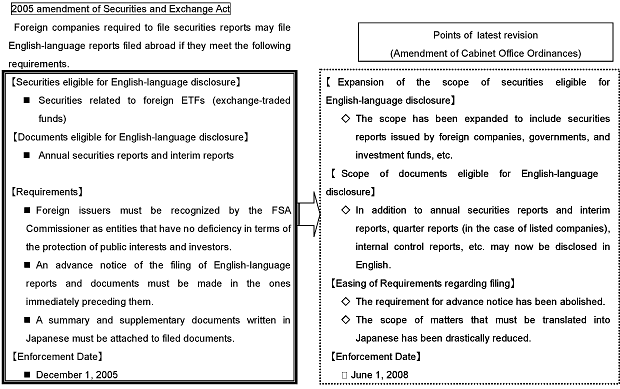
Expansion of Scope of English-Language Disclosure
(i) Expansion of Scope of Securities Eligible for English-Language Disclosure
Before the amendment, English-language disclosure was allowed only for securities related to foreign ETFs (exchange-traded funds). Following the revision, however, English-language disclosure is allowed for all securities issued by foreign companies and other foreign entities (including foreign governments and investment funds).
(ii) Expansion of Scope of Documents Eligible for English-Language Disclosure
Before the amendment, English-language disclosure was allowed for annual securities reports and interim reports. Following the amendment, however, English-language disclosure is also allowed for quarterly reports, confirmation, internal control reports, reports on the conditions of parent companies, etc.
(iii) Easing of Requirements Regarding Filing of English-Language Disclosure Documents
Before the amendment, it was required that foreign issuers planning to make English-language disclosure make advance notice of the filing of English-language reports and documents in the ones immediately preceding them. The amendment abolished this requirement.
(iv) Simplification of English-Language Disclosure
When foreign issuers make English-language disclosure, they are required to attach a summary or supplementary documents written in Japanese to their filed documents. Following the amendment, the scope of matters that must be translated into Japanese has been reduced significantly.
Expansion of Scope of English-Language Disclosure
4. Enforcement Date
" Expansion of Scope of English-Language Disclosure" took effect on June 1, 2008.
For details, please go to the FSA's Website and access "FSA Statement following completion of the public consultation process on the English-Language Disclosure System" (May 30, 2008) and "FSA Publishes its responses to public comments and conclusions on the English-Language Disclosure System" (July 14, 2008) in the "Press Releases" section.
[Minister in His Own Words]
This section provides information regarding the hot topics of the moment, selected from questions and answers given at the Minister's press conferences, etc.
If you wish to find out more, we invite you to visit the "Press Conferences" section of the FSA website.
Q: In your book, in relation to the basic concept concerning financial experts announced by the Financial Services Agency's (FSA) study group on financial experts, you referred to a professional qualification system for the "financial service officer". It is too early to predict how this plan will develop as you are just starting to seek public opinions, and some people in the private sector are worried about the purpose of the plan. Could you tell me again what you think of the qualification system?
A: We have not made up our mind as to whether we should create a qualification system. What we have done is to present the following question: what should we do in order to foster financial experts? The study group is discussing various issues, including a private-sector qualification system. If financial experts, particularly those adept in compliance issues, are spread across various sectors, I believe that sharing of a common view of compliance will proceed in a substantial manner. If such experts are spread across various sectors--at issuer companies, securities companies, self-regulatory organizations and supervisory authorities--it will contribute to maintaining an "eco-system" of the financial sector. This will help prevent administrative costs from ballooning.
As part of liberalization, we have abolished the so-called convoy system, namely that we have abolished an ex-ante regulation system. The administrative cost involved in the ex-ante regulation can be kept very low. As all activities are strictly controlled by laws and regulations, the costs of actual administrative work are relatively low. However, once we switch to an ex-post regulation, we will let the private sector do as it pleases while we tighten enforcement against violations. In this case, the administrative costs can rise sharply. Therefore, we have considered how to allow the private sector to engage in economic activity more freely while curbing administrative costs, and concluded that we need much more financial experts, thus presenting this proposal. We are looking forward to receiving various opinions on this matter.
(Extract from the press conference on May 9, 2008)
[Information]
The FSA has started an E-mail Information Service. If you register your e-mail address on the Subscribe Page of the FSA website, we will notify you by e-mail once on each day when new information is posted on our website. For details, please access Subscribing to E-mail Information Service of the FSA website.
Site Map
- Press Releases & Public Relations
- Press Releases
- Press Conferences
- Official Statements
- FSA Weekly Review & ACCESS FSA
- Speeches
- For Financial Users
- Others
- Archives
- Laws & Regulations
- Name of Laws and Regulations(PDF)

- Recent Changes (Legislation, Ordinances, Guidelines)
- Guidelines
- Financial Instruments and Exchange Act
- Financial Monitoring Policy
- Public Comment
- No-Action Letter System
- Procedures concerning Foreign Account Management Institutions

