




 |
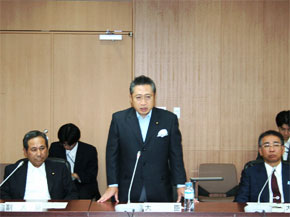 |
Minister Watanabe at an experts' panel meeting on the multiple debt problem (July 15) |
Minister Watanabe at a meeting of the chiefs of the Local Finance Bureaus (July 31) |
[Featured]
[Explanations of Laws and Regulations] [International Affairs] |
[Featured]
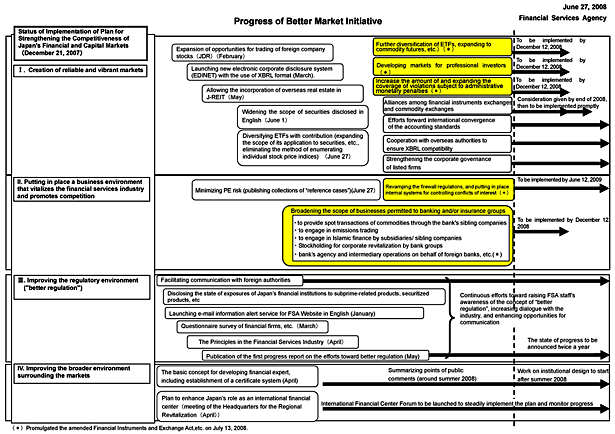
Progress of the Better Market Initiative (Plan for Strengthening the Competitiveness of Japan's Financial and Capital Markets)
The Financial Services Agency (FSA) is vigorously implementing the "Better Market Initiative" (Plan for Strengthening the Competitiveness of Japan's Financial and Capital Markets, December 21, 2007), with a view to establishing attractive and high-quality financial and capital markets to which capital, information and human resources flow into from within and outside Japan.
Substantial progress has been made in the implementation of the Better Market Initiative, as represented by the enactment and promulgation in June this year of the Act for the Amendment of the Financial Instruments and Exchange Act, etc. The FSA announced "Progress of the Better Market Initiative" on June 27, 2008.
Below, we explain the key points of "Progress of the Better Market Initiative" with regard to four areas.
I. Creation of reliable and vibrant markets
(1) Expansion of opportunities for trading of foreign company stocks (developing a framework for secondary markets for JDRs (Japanese depositary receipts))(February 2008)
(2) Launching a new electronic corporate disclosure system called EDINET, which uses the XBRL format (March 2008)
(3) Allowing the incorporation of overseas real estate in J-REITs' (Japanese real estate investment trusts) portfolios (May 2008)
(4) Further diversification of ETFs (exchange-traded funds) with contribution in kind (acceptance of ETFs investing in securities other than stocks, and elimination of the current method of enumerating individual eligible indices) (The measure took effect on June 27, 2008)
(5) Widening the scope of securities permitted to be disclosed in English (permission extended to all types of securities issued by foreign issuers) (The measure took effect on June 1, 2008)
(6) Enactment of the Act for the Amendment of the Financial Instruments and Exchange Act,etc. (promulgated on June 13, 2008)
(i) Further diversification of ETFs (Introduction of ETFs investing in commodity futures, etc.)
(ii) Creation of markets for professional investors
(iii) Raising the amount of administrative monetary penalties and expanding the scope of their application
→ To be implemented by December 12, 2008
II. Putting in place a business environment that vitalizes the financial services industry and promotes competition
(1) Minimizing the "PE risk" to attract foreign fund managers to Japan's markets (exempting "independent agents" from agent PE (permanent establishment)) (April 2008). Publication of collections of "reference cases" (June 27, 2008)
(2) Enactment of the Act for the Amendment of the Financial Instruments and Exchange Act, etc. (promulgated on June 13, 2008)
(i) Revamp of the firewall regulations, and development of a system for controlling conflicts of interest among banking, securities and insurance businesses.
→ To be implemented by June 12, 2009
(ii) Broadening the scope of businesses permitted, to banking and/or insurance groups
* Allowing spot transactions of commodities through banks' sibling companies that have superior risk management
* Allowing banks or insurance firms to directly engage in emissions trading
* Allowing subsidiaries or sibling companies of banks or insurance firms to engage in Islamic finance
* Broadening the scope of exemption, granted to banking and insurance groups, from the restrictions on the holding of shareholder voting rights
* Introduction of a framework for banks' agency and intermediary operations on behalf of foreign banks
→ To be implemented by December 12, 2008
III. Improving the regulatory environment ("better regulation")
(1) Holding extensive dialogue with the parties concerned and publishing the Principles in the Financial Services Industry (April 2008)
(2) Disclosing, earlier than many other countries, the exposures of subprime-related products, securitized products, and the like, held by Japanese deposit-taking financial institutions that were compiled according to uniform standards, and providing information about the impact of the subprime mortgage problem on Japan's financial system (November 2007, February and June 2008)
(3) Strengthening overseas public relations, including the launch of the e-mail information alert service in English (January 2008)
(4) Amid the significant, simultaneous market changes at home and abroad, participating in international discussions toward the stability of financial systems and strengthening cooperation with overseas authorities in order to enhance risk management by financial institutions
(5) Conducting a questionnaire survey of financial institutions (March 2008).
* Nearly 80 percent of the respondents said that the transparency and predictability of regulation and supervision "improved" or "slightly improved."
* Nearly 60 percent of the respondents appreciated the FSA's dialogue with financial institutions. (However, some respondents said that there was still room for improving working-level dialogue.)
* Nearly 80 percent of the respondents appreciated the FSA's strengthening of overseas public relations. (However, some respondents said that there was still room for improving the website contents, etc.)
IV. Improving the broader environment surrounding the markets
(1) Publishing the basic concept for fostering and securing financial experts (April 2008)
→ Summarizing the points of public comments (around summer 2008), and then starting working on institutional design (after summer 2008)
(2) The Headquarters for the Regional Revitalization formulated the "Plan to Enhance Japan's Role as an International Financial Center" (April 2008).
→ Launching an International Financial Center Forum in order to steadily implement the plan and monitor progress
The FSA is determined to continuously implement the following measures in a timely manner, with a view to establishing attractive financial and capital markets.
(1) Forging alliances between financial instruments exchanges and commodity exchanges. (Deliberations will be concluded by the end of 2008, and the relevant revisions will be implemented promptly based on the deliberation results.)
(2) Promoting efforts toward international convergence of accounting standards
(3) Cooperating with overseas authorities to ensure XBRL compatibility
(4) Making efforts to strengthen the corporate governance of listed firms
(5) Making continuous efforts toward achieving better regulation, and publishing the progress thereof every six months, etc.
* For details, please go to the FSA web site and access "Progress of Better Market Initiative (Plan for Strengthening the Competitiveness of Japan's Financial and Capital Markets) (June 27, 2008) from the "Press Releases "section.
FSA Issues the "Reference Cases" and the "Q&A" regarding the "Independent Agent Exemption" of fund managers
With regard to the minimization of the PE risk included in the Better Market Initiative, the FSA held consultations with the authorities concerned and compiled and published "Reference Cases" and the "Q&A" on June 27, 2008.
1. Background
Previously, there was concern that foreign investors investing in Japan through domestic fund managers may be regarded as having a PE (permanent establishment) in Japan and therefore be obliged to declare income and pay tax in Japan (PE risk). This concern was cited as a factor prompting domestic fund managers to move out of Japan.
As the first step to address this problem, the FSA asked for a measure regarding the minimization of the PE risk as part of its requests related to the FY 2008 tax reform. As a result, it has been decided that agents who have an independent status (hereinafter referred to as "Independent Agent" ) should be excluded from the scope of agents treated as permanent establishments (Article 290 of the amended Cabinet Order for Implementing the Income Tax Act and Article 186 of the amended Cabinet Order for Implementing the Corporation Tax Act).
In addition, the FSA held extensive consultations with the authorities concerned, in order to clarify the requirements of an Independent Agent and compiled and published "Reference Cases" and "Q&A" regarding how to determine whether a domestic investment manager conducting certain investment activities under a discretionary agreement with an offshore fund should be treated as an Independent Agent.
2. Key Points of "Reference Cases"
"Reference Cases" comprises the following three sections:
I. The basic concept of applying the provision of an "Independent Agent"
II. The basic concept of applying the provision of an "Independent Agent" to certain investment activities.
III. Case studies regarding the basic concept explained in II.
These sections clarify the following points:
I. The applications of the "Independent Agent" provision of domestic laws are basically consistent with the concepts shown in the commentaries to the OECD "Model Tax Convention on Income and on Capital," which interpret the provision of the "Independent Agent" under the Convention.
Specifically, in order for a domestic fund manager to be treated as an Independent Agent, the manager must meet the following requirements:(i) Legal Independence
The agent must not be subject to detailed instructions or to comprehensive control by the principal.(ii) Economic independence
The agent must bear entrepreneurial risk.(iii) Ordinary course of business
The agent must not engage in activities which belong to the sphere of his principal rather than to that of his own business operations.
II. A domestic investment manager who is registered under the Financial Instruments and Exchange Act and who is conducting certain investment activities under a discretionary investment agreement (DIA) with an offshore fund is treated as an Independent Agent, provided that none of the following circumstances apply:
(i) As the investment decisions that the domestic investment manager is delegated to make under the DIA are extremely limited, the partners of the offshore fund are considered to be directly conducting investment activities in Japan.
(ii) One half or more of the officers of the domestic investment manager concurrently serve as the officers or the employees of the foreign general partner or the foreign investment manager of the offshore fund.
(iii) The domestic investment manager does not receive remuneration linked to the amount of the total assets to be invested under the DIA or to the investment income (remuneration that is adequate, in that it properly reflects contributions made by those involved)
(iv) The domestic investment manager does not have the capacity to diversify its business or acquire other clients without fundamentally altering the way it conducts its business, or loses economic rationality for its business, in cases where the domestic investment manager exclusively or almost exclusively deals with the offshore fund (except for the initial period that follows a business start-up by the domestic investment manager).
3. Key Points of "Q&A"
"Q&A" provides detailed answers to questions about the practical application of the legal concept of independence, in determining whether a domestic investment manager conducting certain investment activities under a DIA with an offshore fund is treated as an independent agent. The explanations are provided from the viewpoint of the following items:
(i) Risk management
(ii) Asset allocation
(iii) Investment restrictions (Negative lists, etc.)
(iv) Investment policy
(v) Investment approvals
(vi) Information exchanges
(vii) Oversight
"Reference Cases" and "Q&A" are intended to clarify the cases where a domestic investment manager conducting certain investment activities under a DIA with an offshore fund is treated as an independent agent, and we believe that they will help to minimize the PE risk and strengthen the competitiveness of Japan's financial and capital markets.
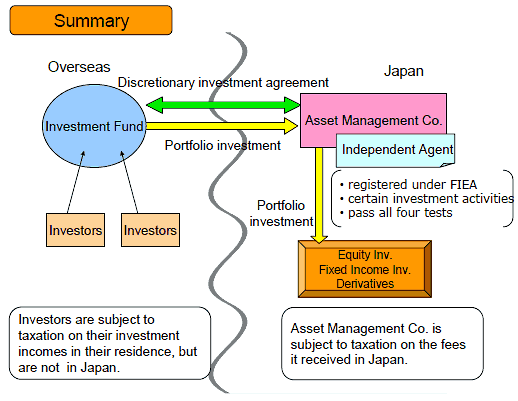
(1) Exclusion of "Independent Agents" from the scope of "agent PE" (Amendment of the Cabinet Order for Implementing the Income Tax Act and the Cabinet Order for Implementing the Corporation Tax Act on April 30, 2008)
(2) Definition of "Independence"
(i) "Reference Cases"
A domestic investment manager who is registered as an entity eligible for undertaking discretionary investment under the Financial Instruments and Exchange Act, and who is conducting certain investment activities (portfolio investment) under a discretionary investment agreement (DIA) with an offshore fund is treated as an independent agent provided that none of the circumstances A) to D) apply.
A) As the investment decisions that the domestic investment manager is delegated to make under the DIA are extremely limited, the partners of the offshore fund (or the foreign investment manager) are considered to be directly conducting investment activities in Japan.
B) One half or more of the officers of the domestic investment manager concurrently serve as the officers or the employees of the foreign general partner or the foreign investment manager
C) The domestic investment manager does not receive remuneration which corresponds to the amount of the total assets to be invested under the DIA or the investment income.
D) The domestic investment manager does not have the capacity to diversify its business or acquire other clients without fundamentally altering the way it conducts its business, or loses economic rationality for its business, in cases where the domestic investment manager exclusively or almost exclusively deals with the offshore fund or the foreign investment manager (except for the initial period that follows a business start-up by the domestic investment manager).
(ii) Clarification through "Q&A" and inquiries made to the National Tax Agency.
* For details, please go to the FSA web site and access "FSA Issued the 'Reference Cases' and 'Q&A' regarding the 'Independent Agent Exemption' of fund managers" (June 27, 2008) from the "Press Releases" section.
[Explanations of Laws and Regulations]
Measures taken after receipt of public comments on the draft Cabinet Order for Partial Amendment of the Order for Enforcement of the Act on Investment Trust and Investment Corporations, etc.
1. Background
The Better Market Initiative (Plan for Strengthening the Competitiveness of Japan's Financial and Capital Markets), which was announced in December 2007, called for the following institutional reform measures, in order to improve convenience for users by diversifying the scope of products handled by exchanges.
(Relevant items included in the Better Market Initiative)
(i) Diversification of ETFs linked to stock price indices
In order to allow more quick and flexible creation of ETFs linked to various indices, government regulations related to the Act on Investment Trusts and Investment Corporations (Investment Trust Act) will be revised within the first half of 2008. The current method of enumerating individual eligible indices in public notices shall be eliminated, and revisions will be made to enable a comprehensive designation of eligible stock price indices to the extent permissible, from the standpoints of ensuring fair pricing and preventing market manipulation.
(ii) Introduction of ETFs investing in listed securities other than stocks
The target of ETFs with contribution in kind under the Investment Trust Act is currently limited to stocks. In view of the fact that various types of ETFs with contribution in kind are listed in overseas exchanges, government regulations related to the Investment Trust Act will be revised within the first half of 2008, and measures will be taken to permit listed non-stock securities that pose no problem from the standpoint of investor protection as investment targets of ETFs with contribution in kind.
In response to the recommendation of these measures, the Cabinet Order for Enforcement of the Act on Investment Trusts and Investment Corporations, as well as the Cabinet Office Ordinance for Enforcement of the Act on Investment Trusts and Investment Corporations were amended.
2. What are ETFs?
Investment trusts listed on exchanges are called exchange traded funds (ETFs). Among ETFs listed on Japanese exchanges are those whose per-unit net asset value is linked to stock indices such as the TOPIX and the Nikkei Average.
ETFs are an investment tool that enables investors to diversify their investment easily and effectively at lower costs compared with investment in individual stocks. In addition, when compared with unlisted investment trusts, ETFs enable more flexible trading decisions as they can be traded in a timely manner at market prices on exchanges.
Under the Investment Trust Act, investment trusts, unless specified otherwise by a cabinet order, are required to be money trusts (trusts established with money and redeemed in money) in principle. However, ETFs are established in accordance with a special provision of a cabinet order that exempts them from this requirement. Under the previous Order for the Investment Trust Act, there were two types of ETFs: "ETFs with contribution and exchange in kind," which are established with cash stocks and whose beneficiary certificates can be exchanged for cash stocks, and "ETFs with contribution in money and exchange in kind," which are established with money and whose beneficiary certificates can be exchanged for cash stocks.
3. Key points of the amendment
(i) Introduction of ETFs with contribution and exchange in kind that invest in listed securities other than stocks
The previous Cabinet Order for Enforcement of the Investment Trust Act allowed the establishment of only ETFs with contribution and exchange in kind that invest in listed securities. The amendment expanded the scope of investment targets of such ETFs to include listed securities other than stocks.
(ii) Expansion of the scope of indices to which ETFs with contribution and exchange in kind may be linked
Previously, ETFs with contribution and exchange in kind were allowed to be linked only to stock indices, and it was required that the individual stock indices to which such indexes are linked be designated through public notices. The amendment eased this restriction so as to allow such ETFs to be linked to indices in general, provided that it is ensured that the calculation of the indexes is objective and fair, in order to prevent the establishment of an ETF linked to an inappropriate index.
The requirement for the designation of individual indices through public notices was abolished.
(iii) Revision of the Scope of ETFs exempted from restrictions on short selling Following the expansion of the scope of indexes to which ETFs with contribution and exchange in kind may be linked, necessary measures have been implemented, including setting an exemption provision regarding restrictions on short selling of ETFs linked to non-stock indices that is similar to the one regarding restrictions on short selling of ETFs linked to stock indices.
(iv) Implementation date
The above amendment of the order and the abolition of the notification requirement was promulgated on June 27 and took effect on the same day.
[International Affairs]
1. On June 27, 2008, the FSA and the United States Securities and Exchange Commission (SEC) held the fourth regular meeting of the high-level bilateral dialogue in Washington D.C. FSA Deputy Commissioner Maruyama and SEC Commissioner Casey participated in the dialogue, together with other high-level staff members from both organizations.
2. In this dialogue, the FSA and the SEC discussed various issues, including issues related to the recent market turmoil, accounting standards, disclosure and enforcement issues.
3. As an increasing volume of securities transactions is done across national borders, the FSA and the SEC face a number of common challenges. Therefore, it is essential for them to enhance exchanges of views and deepen mutual understanding. Given that opportunities for high-level officials of the FSA and the SEC to have face-to-face talks are limited, this dialogue has made significant contributions to the enhancement of the friendship and cooperative relationship between the two organizations.
* For details, please go to the FSA web site and access "FSA and U.S. SEC hold the fourth meeting of the High-Level Dialogue" (June 30, 2008) from the "Press Releases" section.
Authorities responsible for regulation of public companies announce the next steps regarding the creation of a group to interact with the International Accounting Standards Committee Foundation
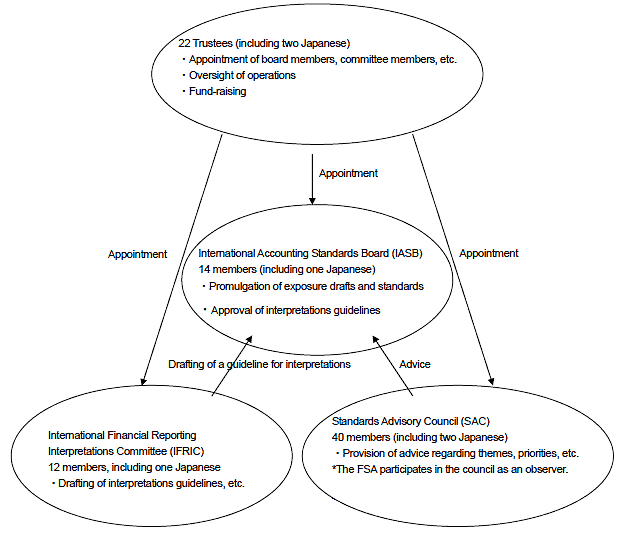
On June 18, 2008, the FSA announced a joint statement with the European Commission (EC), the United States Securities and Exchange Commission (SEC) and the International Organization of Securities Commission (IOSCO), that welcomed the Roundtable regarding the creation of a Monitoring Group of the International Accounting Standards Committee Foundation (IASCF).
The IASCF, a foundation operated by Trustees, is responsible for the appointment of the board members of the International Accounting Standards Board (IASB), which sets the International Financial Reporting Standards (IFRS) and the funding of the board. The use of the IFRS is growing worldwide, and Japan is striving to accelerate the convergence of its standards with the IFRS. In this context, the strengthening of the governance of the IASCF and the IASB through measures such as enhancing the transparency of the process of setting the IFRS, has become extremely important.
The IASCF is now conducting a periodic review of its Constitution, which is done every five years. Before the review started, the FSA, together with the EC, SEC and the IOSCO, issued a joint statement in November 2007, proposing measures for strengthening the governance of the IASCF. In May 2008, the IASCF expressed its intention to first discuss the establishment of relationship with the Monitoring Group and an increase in the number of its board members in the review of its Constitution, and presented a draft discussion document regarding proposals for change. At a roundtable meeting held in June 19, participants including the one from the FSA expressed various views regarding this document. Following this, a discussion document was published for consultation on July 21 (comments to be received until September 20).
The FSA plans to continue supporting efforts to strengthen the governance of the IASCF in cooperation with the EC, the SEC, the IOSCO and other relevant organizations.
For details, please go to the FSA's web site and access "Authorities responsible for regulation of public companies announce the next steps regarding the creation of a Group to interact with the International Accounting Standards Committee Foundation" (June 18, 2008) from the "Press Releases" section.
[Information]
The FSA has started an E-mail Information Service. If you register your e-mail address on the Subscribe Page of the FSA website, we will notify you by e-mail once on each day when new information is posted on our website. For details, please access Subscribing to E-mail Information Service of the FSA website.
Site Map
- Press Releases & Public Relations
- Press Releases
- Press Conferences
- Official Statements
- FSA Weekly Review & ACCESS FSA
- Speeches
- For Financial Users
- Others
- Archives
- Laws & Regulations
- Name of Laws and Regulations(PDF)

- Recent Changes (Legislation, Ordinances, Guidelines)
- Guidelines
- Financial Instruments and Exchange Act
- Financial Monitoring Policy
- Public Comment
- No-Action Letter System
- Procedures concerning Foreign Account Management Institutions

