




 |
 |
Minister Yosano at the first press conference as the Minister of State for Financial Services (February 17) |
Minister Yosano speaking at the Meeting for Exchange of Views for Smooth Financing (February 24) |
[Featured] [Topics]
[Explanations of Laws and Regulations] |
Statements, Speeches & Material
In this corner, we post statements and speeches made by the Minister, the Senior Vice Minister, the Parliamentary Secretary and FSA officials, as well as presentation material they used.
Statements
February 24, 2009
Summary of remarks by Kaoru Yosano, Minister of Finance and Minister of State for Financial Services and Economic and Fiscal Policy, at the Committee on Financial Affairs of the House of Councillors
February 19, 2009
Summary of remarks by Kaoru Yosano, Minister of Finance and Minister of State for Financial Services and Economic and Fiscal Policy, at the Committee on Financial Affairs of the House of Representatives
February 12, 2009
Policy statement by Shoichi Nakagawa, Minister of Finance and Minister of State for Financial Services, at the Committee on Financial Affairs of the House of Representatives
[Featured]
The 5th International Conference “Strengthening Payment Systems : Facilitating Payment and Vitalizing Money Flow in Asia”
The Financial Research and Training Center (FRTC) of the Financial Services Agency (FSA) has hosted international joint conferences of the industrial, academic and government sectors, to discuss themes pertaining to financial practices. The 5th such international conference took place on February 10, 2009 and was held on the theme of “Strengthening Payment Systems: Facilitating Payment and Vitalizing Money Flow in Asia.” Cosponsored by the Asia Development Bank Institute and Keio University Global Center of Excellence Program, it drew some 220 participants, including researchers, government and central bank officials, financial institutions from Japan and other countries as well as officials from foreign embassies in Tokyo.
The payment system is a key element in the infrastructure that supports financial and capital markets and its safety, efficiency and user-friendliness must be upgraded in order to keep up with the changes in society. Backed by the recent innovation in information and communication technology, new forms of payment and settlement businesses represented by e-Money have emerged in Japan and other countries. In addition, activities directed toward customer satisfaction and toward international standardization have commenced with the aim to strengthen coordination and harmonization in payment and settlement systems with other countries.
Amid the current financial crisis, the conference examined what the settlement regime for Asia should be in order to vitalize the money flow in the region. Study was also directed toward the current state and future prospects of the payment systems that support a settlement regime, taking a multifaceted approach to the issue by studying not only system design but other areas including settlement/remittance business technologies.
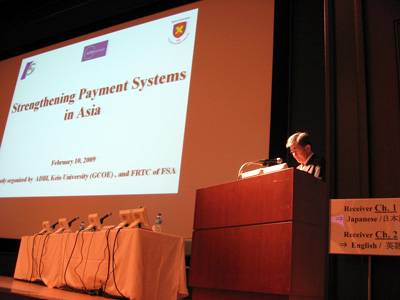
Session I : Capital flows, payment systems in Asia and its relation to financial markets
Session I featured speakers representing Indonesia, Malaysia, Thailand and the Philippines reporting on developments in payment systems and related retail settlement in their respective countries. In each of these countries, e-banking and e-remittance services have been introduced in the retail business sector. Although they differ in the payment tools, such as the Internet, ATM networks and mobile phones, due to differences in government programs and policies, the level of development of the banking industry, and geographical conditions, the speakers reported improvement in user convenience and reduced cost for SME financing costs as a result of diffusion of such payment systems. However, the state of application varies by country, which led to the general understanding that new settlement services are not being used effectively in SME financing.
The presentations on the four countries were followed by comments by the participants from the People's Republic of China and India. Through the comments, the four countries were found to have commonalities in that the wider use of electronic payment had led to a reduced volume of trade settled by cash, and that advances made in payment services were contributing to greater user convenience and cuts in financing costs for SMEs. Alongside the progress in these areas, the discussion pointed to consumers in Asia who do not have bank accounts and cannot access banking services, and suggested that if these people were able to benefit from banking services, it would generate domestic demand and foster economic growth. Furthermore, information literacy among banking service users and those working in the banking industry was also mentioned as a necessary element for further progress in esettlement and mobile banking. There were also comments suggesting that accurate data on settlement and payment must be gathered for study into the relationship between payment systems and capital flow.
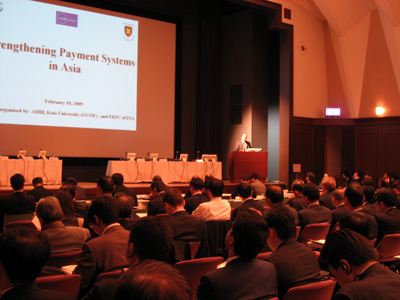
Session II : Sophisticated payment systems, technologies and associated regulatory Issues
In Session II, a report was presented by a private business enterprise on the recent developments concerning new payment services. Also, the FSA and the Bank of Japan reported on their efforts to enhance payment systems. The presentation from the private business perspective featured a new payment service from banks that combined financing, risk reduction, liquidity management, etc. It also introduced new developments in the SME finance businesses that are employing a settlement scheme under the Electronically Recorded Monetary Claims Act which is expected to replace the use of negotiable instruments today. The FSA reported on recent activities in Japan aimed at development of a framework for strengthening payment systems. The report from the Bank of Japan spotlighted activities toward boosting the safety and efficiency of payment systems and actions taken in face of the mounting interdependency among payment systems.
Following these presentations, the participant from South Korea spoke on the subject of regulations related to foreign exchange trade and reported on the recent enactment of a South Korean law that allows investment companies to engage in remittance business. Also, the participant from Hong Kong spoke on the importance of vitalizing capital flow in Asia through “localization of funds flow in the region” and introduced the scheme for harmonizing payment systems currently in development between South Korea and Malaysia.
Session III: Wrap-up session
Session III opened with a presentation by the Ministry of Finance of Japan on the financial cooperation activities in Asia that Japan has carried out to date. The report referred to regional efforts at financial development including the Chiang Mai Initiative and other efforts implemented under the framework of ASEAN+3 (ASEAN nations plus China, Japan and South Korea), amid intensifying closeness in the regional ties of Asian economies, steady growth since the time of the Asian financial crisis, and increased cash flow. The speaker pointed out that the recent financial crisis has further increased the importance of these regional initiatives.
This was followed by a report from Naoyuki Yoshino, Director of the FRTC and professor of economics at Keio University, which summed up the discussions in the three sessions in the following way:
(i) With the scope of settlement/remittance business operators expanding beyond existing financial institutions, along with a growing range of tools available, payment systems are becoming more easily accessible to small-sum users including SMEs, and have become more convenient than ever.
(ii) Competition is necessary in upgrading the efficiency and cutting costs for payment systems. Notwithstanding, there must be a balance between competition, efficiency, and safety, which means that regulatory and supervisory measures are necessary for the safety of payment systems.
(iii) Despite differences in the level of development of financial frameworks and payment systems, as well as differences in accounting systems and technology, creation of a network in Asia is certain to promote the flow of Asian funds within the region.
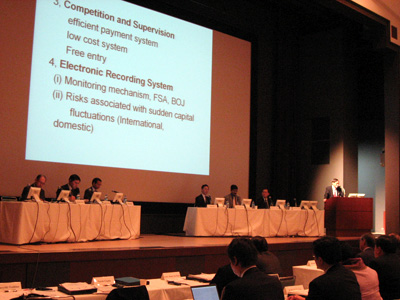
In the panel discussion that followed the wrap-up session, the focus of discussion was the impact of the current financial crisis on payment systems. Although the fact that it did not affect the stability of payment systems in Asia or in the US itself was commended, the discussion pointed to the fact that a desirable payment system for each country differs by the state of its economic development and that issues related to payment systems, including regulation and supervision, differ by country.
Furthermore, participants highlighted some legal issues involved in the institution of a standardized legislative framework regarding payment vis-à-vis the respective state of payment system development. In terms of the level of regulation governing payment systems, they also pointed out that Asian nations are still groping in the dark for solutions to address the two issues of assuring safety and promoting innovation.
The panel discussion concluded with the consensus that, with the effect of financial crisis expected to last, the Asian economy must continue to maintain its stability in view of its huge influence over the global economy, but at the same time that Asia's payment systems require further reinforcement in the hope of generating a new money flow within the region.
[Topics]
On February 10, 2009, the FSA published the status of banks’ non-performing loans as of end-September 2008.
The status of banks’ non-performing loans as of end-September 2008 is as follows:
The total amount of non-performing loans (NPLs) held by all banks as of end-September 2008, based on the definition in the Financial Reconstruction Act (FRA) (Act No.132 of 1998), is 12.3 trillion yen. The figure increased by 0.9 trillion yen from 11.4 trillion yen as of end-March 2008. About increase and decrease of the classification of total amount of NPL, Special attentions loan decreased by 0.3 trillion yen, while relatively high risk Doubtful and bankrupt/de facto bankrupt loan increased by 1.2 trillion yen.
The NPL ratio by all banks is 2.5%, increased by 0.1% compared with end-March 2008.
The total loss amount from the disposal of NPLs from April 2008 to September 2008 was 1.3 trillion yen, increasing by 0.5 trillion yen from 0.8 trillion yen during the same period of 2007.
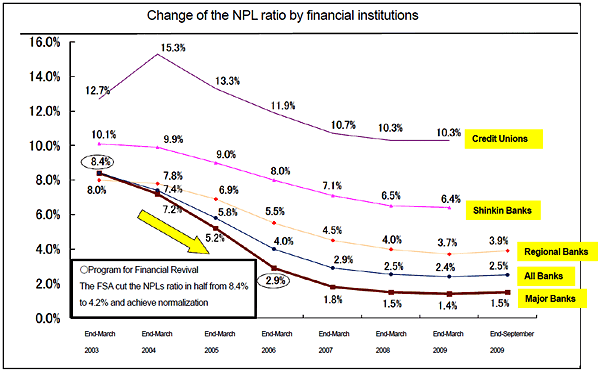
*For further details, please access “The status of banks’ non-performing loans as of end-September 2008” (February 10, 2009) under Press Releases on the FSA website.
Public consultation on the Draft Interim Report: Application of International Financial Reporting Standards (IFRS) In Japan
 Publication of the Draft Interim Report
Since October 2008, the Planning and Coordination Committee of the Business Accounting Council (BAC) had conducted studies on the application of international financial reporting standards (IFRS) in Japan. Following a review conducted in the 15th meeting of the Committee held on January 28, 2009, an agreement was reached on the publication of the findings as a Draft Interim Report in order to widely solicit opinions and comments from the public at large. The Draft Interim Report was published on February 4, 2009. The deadline for receiving opinions and comments is April 6, 2009.
Background of the Review
Amidst international movements toward convergence of accounting standards, action toward convergence is accelerating in Japan. Through the tireless efforts of stakeholders, Japan's accounting standards have won international recognition for equivalence with IFRS. (For EU’s equivalence assessment of accounting standards, please read the FSA Newsletter February 2009.)
In the face of the growing number of jurisdictions that have already adopted the IFRS and those moving toward adoption of the standards outside the European Union, such as the US, IFRS could become the standard system for leading financial and capital markets other than Japan in the future. In the drive to foster greater comparability of financial statements and to increase the international competitiveness of Japanese business corporations under these circumstances, it was pointed out by various stake holders that Japan should develop a roadmap (process chart) for either optional or mandatory application of IFRS in legal financial statement disclosure by Japanese companies in the future and indicate future directions concretely.
Accordingly, Japanese accounting experts discussed how to deal with IFRS upon sharing their medium- to long-term perspectives at the Committee meeting. As global conditions surrounding Japanese accounting standards involve many uncertain factors, the Committee stressed the importance of adapting to changes in future conditions in a flexible manner.
Summary of the Draft Interim Report
(1) Issues to be addressed toward the application of IFRS
Although defining specific details in the roadmap toward IFRS application may be beneficial for the future, it is also important to work actively to address the issues in preparations and adoption in accounting including the following.
(i) Quality of IFRS
(ii) Language to be used upon the application of IFRS
(iii) Due process for setting of IFRS
(iv) Practical measures, training and education for the better understanding of International Accounting Standards Committee Foundation (IFRS)
(v) Strengthening Japan’s involvement in the setting of IFRS and governance of the International Accounting Standards Committee Foundation (IASCF)
(vi) Implementing IFRS in XBRL format
(2) Optional application of IFRS
The Draft Interim Report states that optional application of IFRS may be allowed while defining the future prospects for mandatory IFRS application and steady progress in addressing the issues that must be resolved for IFRS application. In deciding the concrete details of the schedule for the adoption process, the Draft Interim Report refers to the need to identify relevant developments, such as in Europe and the U.S.
Taking into account these developments, the Committee believes that the optional application of IFRS be allowed for consolidated financial statements for certain listed business corporations from, for example, the fiscal year ending March 2010. Regarding the companies to which optional application may be allowed, they are expected to satisfy all of the following requirements :
(i) They have prepared and disclosed appropriate financial statements on an ongoing basis;
(ii) They have put in place an appropriate internal framework for IFRS-based reporting;
(iii) They have developed in-house accounting procedures based on IFRS and disclosed the relevant information in their annual securities reports; and
(iv)They fall under either of the categories of large-scale companies whose financial activities are: (a) conducted internationally; or (b) well recognized in the market.
(3) Considerations for future mandatory application
The Draft Interim Report states that it is appropriate for Japan to be prepared to take on the issue of mandatory application of IFRS in a forward-looking manner, defining the path to be taken in the case of making the use of IFRS by a certain range of Japanese business enterprises mandatory. The Committee believes this is appropriate in view of the need to envisage Japan’s future and from the stand point of providing investors with information that excels in international comparability and of ensuring the international competitiveness of Japan's financial and capital markets. On the other hand, the Report also states that, because of the need to have all market participants make substantial progress in their response to many issues concerning mandatory IFRS application, it is appropriate to make the final decision on the issue of mandatory application based on a thorough assessment of the state of progress made with respect to the issues involved in IFRS adoption.
With this understanding, the target date for the decision on mandatory application may be tentatively scheduled for 2012, although the date may vary due to the status of optional application of IFRS and other developments. If it is decided that the transition to IFRS is appropriate, the Report mentions that the standards should be introduced simultaneously for the consolidated financial statements of all listed companies, provided that a preparation period that is adequate and necessary for adaptation of practices (at least 3 years) is secured.
*For further details, please access “Application of International Financial Reporting Standards (IFRS) in Japan” (a provisional English translation of Draft Interim Report) (February 4, 2009) under Press Releases on the FSA website.
[Explanations of Laws and Regulations]
Partial Revision of the Comprehensive Guidelines for Supervision of Financial Instruments Business Operators, etc.
The FSA invited public comments on the “Draft Partial Revision of the Comprehensive Guidelines for Supervision of Financial Instruments Business Operators, etc” (hereinafter referred to as the “Guideline”) from November 14, 2008 to December 15, 2008. On January 30, 2009, the FSA published the results of the public comment procedure and revised the Guidelines accordingly.
The revisions are outlined below.
1. Revisions Related to the Revamp of Firewall Regulations
(1) Development of a system for managing conflicts of interest
In line with the revamp of firewall regulations by the Act for Partial Revision of the Financial Instruments and Exchange Act, etc. (promulgated on June 13, 2008) and related Cabinet Orders and Cabinet Office Ordinances, securities companies, etc. will be obligated to develop a system for managing conflicts of interest. In response to this, the revised Guidelines provides for basic concepts including that it is desirable for securities companies, etc. to develop governance taking into account the broader scope of undisclosed information exchanged with their parent/subsidiary juridical person, etc. while also giving consideration to the possibility of facing reputational risk, and that the level and depth to which securities companies, etc. manage conflicts of interest do not necessarily have to be the same. In addition, it sets forth the following points of attention regarding supervision:
(i) With regard to developing a system for identifying transactions posing a risk of conflict of interest, whether such transactions are identified and categorized in advance, and whether the contents, characteristics and scale of the business are appropriately taken into consideration in identifying such transactions;
(ii) Whether the company is prepared to be able to choose an appropriate method for managing conflicts of interest or a combination of such methods according to the characteristics of the transaction that has been identified as posing a risk of conflict of interest
(iii) Whether a policy for managing conflicts of interest that contains necessary matters has been formulated and whether an outline thereof that contains necessary matters is publicized appropriately
(iv) Whether the officers and employees are fully informed of the business operation procedures, etc.; whether a conflict of interest controller. manages conflicts of interest in a centralized manner, is securely independent and collects necessary information; and whether the personnel structure and business operation system relating to the management of conflicts of interest are checked periodically
*The “Comprehensive Guidelines for Supervision of Major Banks etc.,” the “Comprehensive Guidelines for Supervision of Small- and Medium-Size and Regional Financial Institutions,” the “Comprehensive Guidelines for Supervision of Insurance Companies” and “Guideline for Supervision of Financial Conglomerates” were also partially revised in the same manner as above.
(2) Exchange of undisclosed information with a parent/subsidiary corporation, etc.
(i) The revised Guidelines set forth the following points of attention with regard to the appropriateness of giving a corporate customer an opportunity for an opt-out:
- Whether the securities company, etc. individually notifies corporate customers of the necessary matters in writing or by any other means; whether it makes necessary information available to corporate customers by constantly publishing the latest information or by providing appropriate explanations in cases where a minor change is made to the contents notified; and whether it notifies a corporate customer of the opportunity for an opt-out again if it has not given such notification for about one year, such as in the case of having concluded a long-term contract
- Whether the securities company, etc. secures a period necessary for the corporate customer to determine whether or not to opt out, from the time of notifying the opportunity for the opt-out until the start of exchange of undisclosed information with its parent/subsidiary juridical person, etc.
- Whether the securities company, etc. constantly publishes the necessary information concerning the opportunity for an opt-out in addition to notifying corporate customers of such information individually, and makes it clear to such customers that the opportunity for an opt-out is always available
- In cases where there are any corporate customers to whom an opportunity for an opt-out is not given (meaning corporate customers whose undisclosed information is to be exchanged with a parent/subsidiary juridical person, etc. only if they have opted in), whether the securities company, etc. discloses information on the attributes of the corporate customers to whom an opportunity for an opt-out is given (or not given)
The revised Guidelines set forth the following points of attention with regard to exchange of undisclosed information with a parent/subsidiary juridical person, etc.
- Whether the scope of undisclosed information to be exchanged with a parent/subsidiary juridical person, etc. is specified
- Whether sufficient measures for information system management are taken with regard to the undisclosed information
- Whether undisclosed information is managed in a centralized manner by a person responsible for managing such information; whether unshared information (meaning undisclosed information relating to corporate customers who have opted out or customers who have not opted in) is managed separately from the other undisclosed information; whether the management status of undisclosed information and unshared information is checked periodically
- Whether measures are taken for allowing the person responsible for managing undisclosed information or the like to demonstrate a sufficient check function against the sales divisions, etc., including prohibition of an employee from working concurrently for both a sales division, etc. and an internal control division
- Whether the procedures for handling undisclosed information and other related matters are clarified in writing or by other means, and whether the officers and employees are fully informed of such matters through training, etc.
- Whether measures are taken for ensuring that an employee of a sales division, etc. cannot access unshared information other than such information managed by a single juridical person, etc. and does not solicit customers by using unshared information managed by a juridical person, etc. other than that managing the unshared information to which the employee has access
(iii) The revised Guidelines set forth the following points of attention with regard to the exchange of undisclosed information (including unshared information) necessary for conducting internal control operations, etc.:
- Whether measures are taken for preventing leakage of undisclosed information from internal control divisions, etc., including prohibition of an employee from working concurrently for both a sales division, etc. and an internal control division, etc.
- In cases where an officer, etc. receives provision of unshared information for the purpose of business management or internal control, whether appropriate measures are taken such as prohibiting use of such information for any other purpose
(iv) The revised Guidelines set forth the following points of attention with regard to measures for preventing misrecognition when an employee concurrently engages in both duties of the securities company, etc. and those of a parent/subsidiary juridical person(s), etc.:
- Whether the scope of services provided within the same branch and the name(s) of the juridical person(s) offering such services are displayed
- Whether the employee engaging in sales clearly indicates the scope of the parent/subsidiary juridical person(s), etc. for which he/she is concurrently performing duties, and whether a customer, upon concluding a contract, is provided an opportunity to recognize the entity which is the counterparty to the contract through confirmation in writing or by other means
(3) Underwriting of shares issued by a parent/subsidiary juridical person, etc.
The revised Guidelines set forth the required experience in underwriting operations and in serving as a lead managing underwriter for an independent managing underwriter to be involved in deciding the issue price of the shares in cases where the securities company, etc. serves as the lead managing underwriter for shares issued by its parent/subsidiary juridical person, etc.
2. Other Revisions
In light of the recent changes in the environment surrounding the financial and capital markets, the Guidelines have incorporated the following revisions:
(i) Added supervisory points concerning the preparedness for customer solicitation and explanations in relation to derivative transactions, etc.
(ii) Clarified supervisory points concerning the control environment for managing liquidity risk of securities companies.
(iii) Indicated the responses to be taken in cases where the supervisory authorities learn information about business continuity problems of a Type II Financial Instruments Business Operator or an Investment Advisory and Agency Business Operator, which is neither subject to the minimum net asset requirement or the monitoring of the capital adequacy ratio.
(iv) Indicated points of attention concerning the handling of the money delivered due to merger in cases where an investment corporation conducts an absorption-type merger and those concerning cases where an investment corporation makes a forward commitment.
(v) Indicated matters concerning preparation, publication and updating of the list of qualified institutional investors and other business operators engaging in specially permitted businesses.
3. Effective date
Among the revisions of the Guidelines, those concerning the revamp of firewall regulations will become applicable from June 1, 2009. Any other revisions are effective from January 30, 2009.
This section provides information regarding the hot topics of the moment, selected from questions and answers given at the Minister's press conferences, etc.
If you wish to find out more, we invite you to visit the “Press Conferences” section of the FSA website.
[Opening remarks]
Shortly past nine today, Prime Minister Aso appointed me to serve as Minister of Finance and Minister for Financial Services. As I am now in charge of three ministerial roles, I will do my best to perform my duties so as to obtain Diet approval for bills and the budget. As we are in the economic situation we are in, my mission is to tackle this economic crisis, and it is also important for Japan to devote efforts to international cooperation while remaining mindful of the global economy, rather than focusing exclusively on domestic matters. Therefore, I would like to work on fiscal and financial measures as well as future economic measures in general while seeking the understanding of the people. I would appreciate your cooperation.
Q : Serving concurrently in three ministerial posts carries extremely heavy responsibilities and balancing the duties is a difficult issue. Could you tell us specifically on which policy areas you will give priority?
A. Now that we are in this situation, one policy area is facilitating credit flow, namely, getting the entire financial sector moving smoothly, and another is stimulating demand. Thus, financing and demand are two policy areas we need to tackle. I believe that the government has taken adequate measures under the first and second supplementary budgets for fiscal 2008 and the initial budget for fiscal 2009. However, the QE (preliminary data on quarterly GDP) announced yesterday indicated an economic slump that confounded common sense and was far sharper than we expected, and I think that the people’s response to this will be the most important point. From now on, various opinions will be heard from the industry, academic circles and the press, so the government will need to deal with the situation while adequately taking into consideration these opinions as well as the voice of the people.
Q : I understand that this is the second time that you are serving as Minister for Financial Services. Could you tell us what the differences are between the situation that you faced previously and the current crisis situation, and how you intend to maintain cooperation in relation to international crisis management measures?
A. The scope of the duties of the Minister for Financial Services covers not only banks but also life and non-life insurance companies and other financial industries, and I think all of these are relatively sound, compared with their equivalents in other countries. However, it is true that major companies as well as small and medium-size enterprises (SMEs) have suffered a heavy blow from sharp drops in order receipts caused by a considerable decline in exports as they approach the end of the fiscal year in March. Furthermore, the fund-raising condition is becoming severe. Companies are facing this situation no matter whether they are major companies or SMEs, so probably the FSA’s greatest challenge for the moment is how to deal with the issue of financing.
(Extract from the press conference on February 17, 2009)
[Information]
The FSA has started an E-mail Information Service. If you register your e-mail address on the Subscribe Page of the FSA website, we will notify you by e-mail once on each day when new information is posted on our website. For details, please access Subscribing to E-mail Information Service of the FSA website.
Site Map
- Press Releases & Public Relations
- Press Releases
- Press Conferences
- Official Statements
- FSA Weekly Review & ACCESS FSA
- Speeches
- For Financial Users
- Others
- Archives
- Laws & Regulations
- Name of Laws and Regulations(PDF)

- Recent Changes (Legislation, Ordinances, Guidelines)
- Guidelines
- Financial Instruments and Exchange Act
- Financial Monitoring Policy
- Public Comment
- No-Action Letter System
- Procedures concerning Foreign Account Management Institutions

