| [Primer on Financial Literacy】 |
 |
| * | This section provides easy-to-understand explanations on financial terms and
various questions related to financial matters which tend to be too specialized
and hard to understand. Keywords of the month: ''civil penalty system'' and ''procedures for judgment''. |
||
In order to broaden the base of participants in the securities market and allow everyone--including individual investors--to participate in the market with peace of mind, it is important to ensure fairness and transparency in the securities market and establish a market that can win investors' trust. To this end, a civil penalty system was introduced in April 2005 as an administrative measure designed to impose a financial burden on violators of the Securities and Exchange Law, with the aim of preventing illegal acts which undermine confidence in the securities market and ensuring the effectiveness of regulations. Violations subject to penalties are: (1) unfair trading (insider trading, market manipulation, spreading of rumors or deception); (2) misstatements in issued and disclosed documents such as securities registration statements; and (3) misstatements in continuously-disclosed documents such as securities reports ((3) became subject to penalties on December 1, 2005). |
|||
|
|||
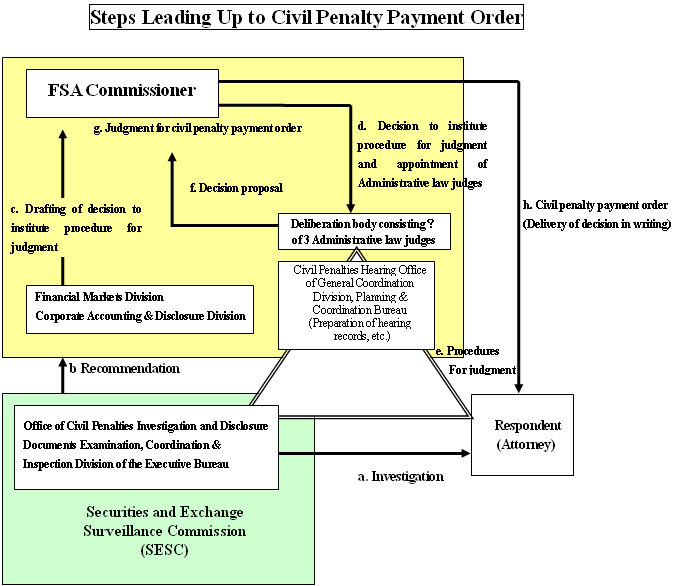
The civil penalty payment order is designed to be issued after an administrative hearing (procedures for judgment) in order to carefully implement the new penalty system. As a general rule, the procedures for judgment take place with open doors based on a deliberation body consisting of three Administrative law judges. Anyone who has been involved in the investigation of the case is not allowed to take charge of the case as an Administrative law judge. In addition, there are provisions to ensure fairness and impartiality in the procedures for judgment: for example, various powers in the procedures for judgment (such as making decisions on the hearing of opinions and examination of evidence) are stipulated as powers unique to Administrative law judges. It should be noted that in the procedures for judgment, the party subject to the civil penalty payment order (respondent) or his/her attorney can appear on the hearing date to state his/her opinions and petition for the examination of various types of evidence (examples: questioning of unsworn witnesses (so-called ''witnesses'' in judicial trials), expert opinions, submission of documentary and/or material evidence). (However, no hearing will be held if the respondent submits a plea accepting the facts of the violation and the amount of the civil penalty as stated in the notice of the decision to institute procedures for judgment prior to the date of the first hearing). On the other hand, officials designated by the FSA Commissioner (designated officials) on the administration side can also participate in the procedures and file for evidence and take other necessary actions in the procedures for judgment. After going through the aforementioned procedures for judgment, Administrative law judges prepare a decision proposal on the case and submit it to the FSA Commissioner, who in turn issues a civil penalty payment order based on the decision proposal if any facts of violations are identified. The Civil Penalties Hearing Office of the General Coordination Division, Planning and Coordination Bureau assists the Administrative law judges on the hearing dates, and performs court-clerk-like duties such as preparing and managing hearing records and ensuring the appearance of respondents and unsworn witnesses. (The Civil Penalties Hearing Office also takes charge of duties associated with the payment and collection of penalties after a judgment has been made for a civil penalty payment order). The FSA is committed to striving to establish a securities market in which everyone--including individual investors--can participate with peace of mind, through the precise implementation of the civil penalty system. |
|||
[Appendix] |
|||
|
|||
|
|
|||
|
|
|||
| [Hot Picks from the Financial World】 | ||||||
|
|
||||||
|
||||||
|
||||||
A. |
TSE is a place where all shares are traded. If it just prevents companies with certain types of shares permitted under the Companies Act from being listed, it means they are being rejected on the grounds of TSE's listing criteria despite being permitted under the Companies Act. Such a scenario seems impossible, as a matter of logic. It is probably impermissible to undermine other shareholders' rights by suddenly creating ''golden shares'' or by other such means. It would be a completely different story if they were created with the consent of most of the shareholders, but if a company arbitrarily creates them, it would have the effect of severely restricting or nullifying the voting rights of other shareholders, so I think it is not permissible as a matter of logic. However, if a company with ''golden shares''--as corporate defense measures permitted under the Companies Act--is to be listed for the first time, the fact would be known by the public and be broadly known by the shareholders. If a company is deemed not to fulfill the listing criteria because of its ''golden shares'', then the listing criteria would be narrowing down the types of shares permitted under the Companies Act. This would not be logical. As a matter of course, various rights granted to shareholders as a result of holding the shares should not be restricted by the creation of ''golden shares''. |
|||||
| (from the press conference following a cabinet meeting on Tuesday, November 22, 2005) | ||||||
|
A. |
If you look at it on an annual and semiannual basis, it is certainly wonderful that they made a profit. It is proof that they are making management efforts, striving to improve efficiency and pushing ahead with streamlining to a certain extent. However, they still have debts and losses from the past in the form of losses carried forward. The amount is something like 12 to 13 trillion yen. It may still take a while until this issue is completely resolved. Therefore, in the next stage, a number of challenges remain: in terms of finance or taxation, separately from the bank management, they must determine when to eliminate the losses carried forward, when they can really start paying dividends after eliminating them, when they can start paying corporation tax, and how they should pay back the injected capital. |
|
| (from the press conference following a cabinet meeting on Friday, November 25, 2005) | ||
|
A. |
It is highly regrettable that a human error led to such a serious situation. It is also very unfortunate that the error caused Mizuho Securities to incur a loss and exerted a serious blow to the company's profit and loss picture. Personally, I earnestly hope that the issue will be resolved promptly to ensure that confidence in the Tokyo Stock Exchange will remain intact. As for Mizuho Securities, I have no reason to be concerned about the adequacy of the company's funds available for settlement, as it is a member of the Mizuho Financial Group. Trading will be suspended all day today for reasons of an abnormal order in accordance with the rules of the Tokyo Stock Exchange. The 13th will probably be the date of stock delivery. I think that various possible solutions will be explored before the day. I believe that the majority of the more than 600 thousand shares that were sold have already been bought back. At this point, it is not known how many are still left. In my opinion, a resolution should be urgently sought for these shares. Aside from the question of how experienced the person who operated the terminal is, I think it is necessary to examine Mizuho Securities' system and the system of the Tokyo Stock Exchange, although there probably was no error on the part of the Tokyo Stock Exchange, so as to find out whether or not it would have been possible to mechanically halt the human error. What the FSA has to do first and foremost is to find out facts in detail. Once we have the details, we will then move on to the determination of what is required under laws and regulations. |
|||||
| (from the press conference following a cabinet meeting on Friday, December 9, 2005) | ||||||
|
||||||
A. |
I realize that transactions were consummated on the exchange floor in a legal sense. However, dealing departments' buying up shares to profit, instead of providing broker services to process customer's orders, while being fully aware that the order had been placed by mistake does not paint a nice picture. I think that even securities companies' management should abide by the aesthetics of conduct. A while ago, a book was published that contained numerous heart-warming anecdotes. This latest conduct is not something that can make its way into the book. |
|||||
| (from the press conference following a cabinet meeting on Tuesday, December 13, 2005) | ||||||
|
|
| Financial Services Agency Home page >> FSA Newsletter >> January 2006 |