
 Search



 |
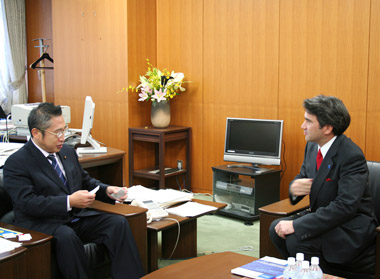 |
| Minister Watanabe had a meeting with Mr. Charles Lake, President of ACCJ (October 31) |
| Table of Contents |
[Statements, Speeches & Material]
This corner is information of Statements, Speeches & Material of the Minister, the Senior Vice Minister, the Parliamentary Secretary and FSA officials
Official Statements
Summary of Remarks by Yoshimi Watanabe, Minister of State for Financial Services, at the Committee on Financial Affairs of the House of Representatives and at the Committee on Financial Affairs of the House of Councillors (The 168th Extraordinary Diet Session)
Speeches
''Toward Better Regulation'' speech by Takafumi Sato, Commissioner of the Financial Services Agency
[TOPICS]
The Financial Instruments and Exchange Act, which came into force on September 30, 2007, specifies the definition of interests in so-called collective investment schemes (funds) in order to eliminate the loopholes in the existing legal framework and protect users, against the background of ongoing change in the environment surrounding the financial and capital markets. Specifically, business operators selling rights to investors regarding schemes that (1) collect monetary investments and other forms of contributions from other parties, (2) engage in business or make investment with the use of the funds, etc. thus collected, and (3) distribute profits earned from said business, etc. to investors (such rights shall be collectively regarded as "securities" subject to regulation under the Financial Instruments and Exchange Act, regardless of their legal forms or the nature of the businesses to which they are related), or business operators that engage in investment of assets provided by investors (limited to investment in securities and the like), shall be subject to supervision by the Financial Services Agency (FSA) and the Local Finance Bureaus and be obligated to register or file a notification with the authorities.
Furthermore, from the viewpoint of investor protection, the Financial Instruments and Exchange Act specifies the provisions with which such fund business operators must comply when selling their products and soliciting customers.
Behind the decision to subject fund business operators to supervision is the fact that there have recently been many cases of financial damage arising from anonymous association-type funds for business enterprise, which are designed for ordinary investors. It is important for ordinary investors to turn down solicitation when the necessary details of transactions are unclear, or when there is doubt as to the reliability of the soliciting business operator. Furthermore, ordinary investors should be vigilant against solicitation by non-registered business operators. Even in the case of registered business operators, it is essential to assess their creditworthiness and understand the necessary details of transactions.
* For a list of registered business operators, please access the FSA's Web site.
The Financial Markets Strategy Team (chaired by Yoshikazu Takao, Executive Director of Asahi Life Asset Management Co.) was established as an advisory group under Financial Services Minister Yoshimi Watanabe and held its first meeting on September 19, 2007.
The Strategy Team was established for the purpose of collecting and analyzing information relating to the subprime mortgage problem that originated in the U.S. housing market and has grown into an international issue, affecting financial markets around the world in various ways, through active exchanges of views and discussions conducted by experts on matters concerning financial and capital markets and regulatory officials. Reflecting this purpose, the group comprises members who have advanced expertise related to financial and capital markets and the subprime mortgage problem.
So far, the Strategy Team has held five meetings, on September 19 and 21 and October 5, 18 and 25.
At the first meeting, representatives from the Financial Services Agency and the Bank of Japan provided briefings on domestic and overseas developments related to the subprime mortgage problem, after which members exchanged views on the problem and engaged in free debate.
At the second meeting, members provided briefings on developments in the financial markets and the impact of the conditions of the U.S. housing market on the economy, and then the group engaged in free debate.
At the third meeting, Masahiro Kobayashi of Japan Housing Finance Agency and Tomomi Kikuchi of JP Morgan Securities were invited to provide briefings on the U.S. housing market. After their briefings, the group engaged in free debate.
At the fourth meeting, members provided briefings on key issues related to credit rating agencies and regulations on investment funds, and a representative from the Financial Services Agency explained the Basel II banking regulatory regime, after which free debate was conducted.
At the fifth meeting, Nana Otsuki of UBS Securities and Atsuo Akai of Morgan Stanley Japan Securities were invited to provide briefings on developments in the credit market and on practical affairs concerning the securitization business, respectively. After their briefings, the group engaged in free debate.
As for the future schedule, the Strategy Team plans to compile an interim report around the middle of November, after conducting further debate.
The Securities and Exchange Surveillance Commission (hereinafter referred to as the "SESC") on September 26, 2007 published the Inspection Manual for Financial Instruments Business Operators (hereinafter referred to as the "Inspection Manual"), which was formulated as a result of a drastic review and revision of two existing manuals, namely the Inspection Manual for Securities Companies and the Inspection Manual for Investment Trust Management and Investment Advisory Businesses.
The SESC adopted the new manual in response to expansion of the scope of business operators subject to inspection and of inspection items, following the introduction of cross-sectoral regulation due to the full enforcement of the Financial Instruments and Exchange Act on September 30, as the Inspection Manual for Securities Companies and the Inspection Manual for Investment Trust Management and Investment Advisory Businesses are insufficient to fully cover the expanded scope.
Note: The Inspection Manual serves as a handbook that sets forth a basic approach to inspection of securities businesses to be conducted by inspection authorities such as the SESC and the Local Finance Bureaus, and specific supervisory issues to be examined in inspections.
*Key Points of Inspection Manual
1) Expansion of Scope of Business Operators Subject to Inspection
The Inspection Manual was formulated so as to cover a broad scope of business types, including those being subjected to regulation for the first time (e.g., business operators engaged in investment of funds available in the form of interests in collective investment schemes), with due consideration of the cross-sectoral business classification for regulatory purposes that was introduced upon the enforcement of the Financial Instruments and Exchange Act. As a result, the Inspection Manual covers:
(a) Type I financial instruments businesses (securities companies, foreign securities companies, financial futures business operators, etc.);
(b) Type II financial instruments businesses (business operators handling investment trust beneficiary certificates, trust beneficiary rights, commodities funds, etc.);
(c) Investment advisory and agency businesses (investment advisory companies, etc.);
(d) Investment management businesses (investment trust management companies, companies engaged in discretionary investment, companies engaged in management of "funds," etc.);
(e) Registered financial institutions;
(f) Investment corporations.
Note: Furthermore, some of the inspection items regarding Type I financial instruments business operators and investment management business operators shall be applied to the inspection of financial instruments intermediaries and specially-permitted business-notifying persons, such as qualified institutional investors.
2) Specification of Ideal Status of Financial Instruments Business Operators, etc.
Under the Securities and Exchange Trade Act that preceded the Financial Instruments and Exchange Act, regulatory authorities were empowered to take administrative disciplinary actions, such as issuing a business improvement order when any violation of a specific regulatory provision was identified. However, when problems were identified that were not so serious as to constitute a violation of laws and regulations, it was customary to go no further than notifying the relevant securities companies and the supervisory departments as a way to contribute to the establishment of an appropriate control system.
Meanwhile, under Article 51 of the Financial Instruments and Exchange Act that has recently come into force, a business improvement order may be issued with regard to cases that do not constitute a violation of laws and regulations if it is deemed "necessary and appropriate for the public interest and protection of investors." With this provision in mind, the Inspection Manual specifies the ideal status of financial instruments business operators, etc. based on the principles set by the International Organization of Securities Commissions (IOSCO), among other rules and principles, in order to enable the authorities to determine, when considering whether to apply the provision of Article 51, whether there is any problem with the inspected business operators compared with the ideal status.
The FSA believes that grasping the internal control systems of the inspected business operators, comparing them with the "ideal status" and focusing on weaknesses thus identified will help to enhance the efficiency of inspection.
3) Structure of the Manual
In order to pay increased attention to the internal control systems of the inspected business operators, the section for inspection items regarding systems (system section) was separated from the section for inspection items regarding the execution of business operations (business execution section). The system section sets forth inspection items necessary to examine the status of the establishment and improve the control system for ensuring appropriate business operations, while the business execution section sets forth inspection items necessary to examine the appropriateness of all business operations conducted (e.g., status of compliance with laws and regulations) by the inspected business operators. Furthermore, both the system section and the business execution section set forth not only inspection items commonly applicable to all business types, but also items specific to each business type, thus making it easy to conduct proper inspection according to the type of business.
*Nature of Inspection Items and Specific Examples of Conduct Described as Ideal for Financial Instruments Business Operators
Specific examples of conduct described as ideal for financial instruments business operators and inspection items set forth in the Inspection Manual are merely examples provided so as to help inspectors grasp the actual status of the inspected business operators, and the SESC does not necessarily require the inspected financial instruments business operators to establish the internal control system in exactly the same way as described in the manual with regard to each inspection item. In other words, in cases where the inspected business operator's conduct does not match the requirement specified in the manual with regard to each and every item, the SESC shall not necessarily recommend any action against the business operator. Even in such cases, the business operator may be assumed to have in place an appropriate internal control system suited to the type, profile and scale, etc. of its business, and the SESC shall seek full explanations as to the internal control system and make sure to judge the inspection results in light of laws and regulations.
The Certified Public Accountants and Auditing Oversight Board (CPAAOB), based on Article 16 of the CPAAOB Operational Regulations, publishes an annual report on its activities after the end of each business year. Accordingly, on September 28, 2007 the CPAAOB issued a report on its activities in Business Year 2006 (from July 2006 to June 2007), the outline of which is as follows:
(Oversight and Inspection of Quality Control Review)
In Business Year 2006, the CPAAOB inspected small and medium scale audit firms, identified deficiencies regarding quality control at such audit firms and issued the report of the inspection results in March 2007 (an interim report was published in November 2006). Based on the inspection results, the CPAAOB recommended to the Commissioner of the Financial Services Agency (FSA) to take disciplinary action against two audit firms under the Certified Public Accountants Law (a similar recommendation was made with regard to another audit firm in July 2007). In addition, the CPAAOB conducted inspections of the improvement of their audit quality control management by the Big Three audit firms, omitting Misuzu Audit Corporation, and published the inspection results in June 2007.
In light of the results of activities in the first term (from Business Year 2004 to 2006) following its establishment and based on the new basic policy and plan on examination and inspection, the CPAAOB is to urge audit firms in the second term to ensure that improvement is made and maintained with regard to the identified deficiencies in quality control.
(Introduction of new CPA Examination)
The CPAAOB started a new CPA examination in January 2006 under the amended CPA Law and announced successful applicants in November.
(Deliberations of Disciplinary Actions)
The CPAAOB is required under law to conduct deliberations on the validity and severity of disciplinary actions against CPAs / audit firms before the FSA makes a decision on such actions. In Business Year 2006, such deliberations were conducted in six cases.
(Cooperation with Relevant Foreign Organizations)
At the Paris roundtable meeting of independent audit regulators in September 2006, an agreement was reached on the establishment of a new international forum called the International Forum of Independent Audit Regulators (IFIAR). The first meeting of IFIAR was held in Tokyo in March 2007, hosted by the CPAAOB, laying the foundation for the new forum's future activities.
The CPAAOB intends to ensure the fairness, independence and reliability of audits, and meet the expectations of investors or serve the public interest by performing its duties while cooperating with audit regulatory bodies in other countries.
The second meeting of the International Forum of Independent Audit Regulators (IFIAR) was held in Toronto on September 24-25, 2007.
The IFIAR is an international organization for audit regulatory organizations, established in order to serve public interest and enhance investor protection through improving audit quality , and its core activities are to share knowledge gained from experiences in various countries and to promote cross-border cooperation. It comprises 22 member countries and 8 observer international organizations. At the Toronto meeting, as at the first meeting held in Tokyo in March 2007, there was an active exchange of views between audit regulatory organizations from around the world with regard to various issues of concern relating to the quality of audits.
At the Toronto meeting, Japan explained its new notification regime for foreign audit firms, which is to be introduced in April 2008. Based on the revised CPA Law Japan also made a presentation on the results of follow-up inspections of the Big Three audit firms, which were published at the end of June 2007 by the Certified Public Accountants and Auditing Oversight Board (CPAAOB).
There was also an active exchange of views on other issues such as possible implications of the current market turbulence for audit regulators, exchange of information between regulators, audit market concentration and choice, and the future role and organization of the IFIAR.
In addition, it was decided that the second inspection workshop will be held in Berlin, following the first workshop held in Amsterdam in May 2007, with a view to sharing audit inspection techniques and experiences, which is a core objective of the IFIAR.
The CPAAOB will continue to endeavor to improve the quality of audits by establishing and enhancing cooperative and collaborative relations with audit regulatory organizations in other countries.
* For details, please access to  The Second Meeting of the IFIAR (Toronto Meeting)
[Featured]
1. Introduction
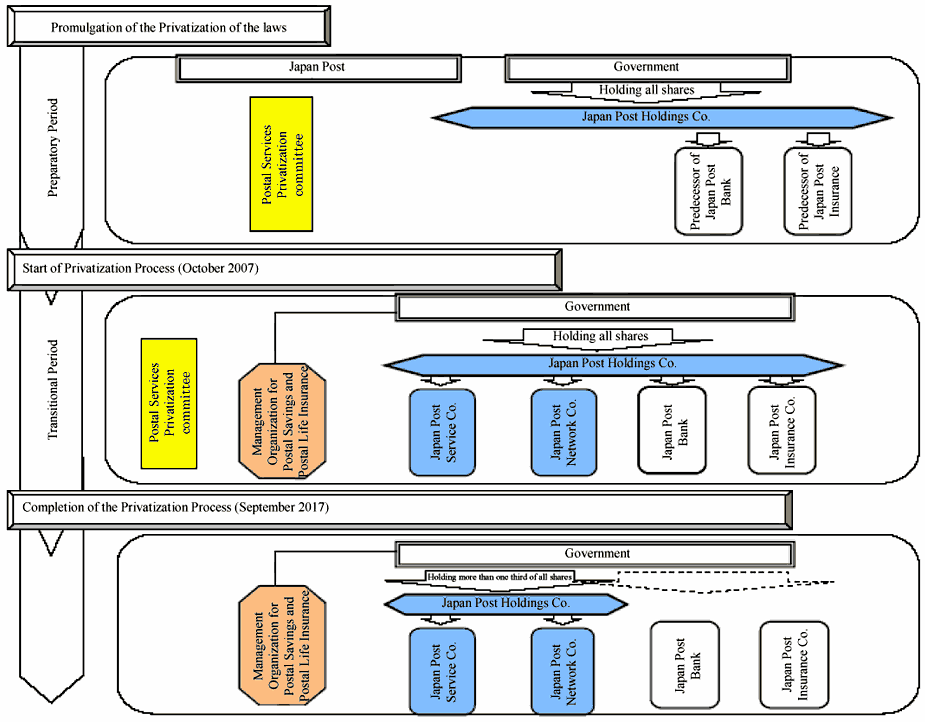
As a result of the privatization of the postal services implemented on October 1, 2007, Japan Post Group was established, with Japan Post Holdings Co. serving as the group's holding company and Japan Post Service Co., Japan Post Network Co., Japan Post Bank and Japan Post Insurance Co. placed under it as subsidiaries. Japan Post Bank and Japan Post Insurance are subject to supervision by the Financial Services Agency (FSA) now that they have been turned into private financial institutions.
Therefore, we will explain the framework for the FSA's supervision of Japan Post Bank and Japan Post Insurance, referring to the outline of the process of privatization of the postal services.
2. Outline of the Privatization of the Postal Services
(1) History of the Privatization of the Postal Services
| September 2004 | Cabinet decision made on the "Basic Policy on the Privatization of the Postal Services." |
|---|---|
| October 2005 | 6 laws related to privatization of the postal services enacted. |
| January 2006 | Japan Post Holdings Co. established. |
| January 2006 | "Basic Plan for Succession of Japan Post's Business Operations" decided. |
| April 2006 | Postal Services Privatization committee established under the Headquarters for the Promotion of Privatization of the Postal Services. |
| December 2006 | "Opinions Regarding Deliberations on New Businesses of Japan Post Bank and Japan Post Insurance" published by the Postal Services Privatization committee. |
| April 2007 | "Plan for Implementing Succession of Japan Post's Business Operations" (hereafter "implementation plan") submitted by Japan Post Holdings Co. |
| June 2007 | Opinions on the implementation plan published by the Postal Services Privatization committee. |
| September 2007 | Implementation plan approved by the Ministry of Internal Affairs and Communications and the FSA.(*) |
| October 2007 | Privatization of the postal services implemented. |
* See "Approval for Implementation Plan Regarding Succession of Japan Post's Businesses, etc." (September 10, 2007)
(2) Schedule of the Privatization of the Postal Services
1) Preparatory Period (until the end of September 2007)
Japan Post Holding Co. was established as a preparatory company, with the predecessors of Japan Post Bank and Japan Post Insurance also set up under the holding company. Postal Services Privatization committee was established under the Headquarters for the Promotion of the Privatization of the Postal Services and was assigned the jobs of (a) providing opinions when the competent minister grants approval to an expansion of the scope of the new postal companies' businesses, etc. and (b) conducting a comprehensive review of the progress status of the privatization of the postal services every three years and providing opinions to the chief of the Headquarters for the Promotion of the Privatization of the Postal Services (the Prime Minister) based on that review.
2) Transitional Period (up to 10 years from October 1, 2007)
Under the wing of Japan Holdings Co., Japan Post Service Co., Japan Post Network Co., Japan Post Bank and Japan Post Insurance Co. started operations. In addition, an incorporated administrative agency called Management Organization for Postal Savings and Postal Life Insurance was established to manage postal savings and postal life insurance contracts taken over from Japan Post.
During the transitional period, the government will sell shares in Japan Post Holdings Co. (note: the government will continue to hold more than one third of all shares in the company), and Japan Holdings Co. will release all of its shares in Japan Post Bank and Japan Post Insurance through gradual sales.
The scope of businesses undertaken by Japan Post Bank and Japan Post Insurance will be limited during the transitional period compared with the scope of operations allowed for ordinary private banks and insurance companies. This restriction will be gradually eased upon approval from the FSA and the Ministry of Internal Affairs and Communications.
3) Completion of the Privatization Process
By the end of September 2017 at the latest, Japan Post Holdings Co. is required to sell off all of its shares in Japan Post Bank and Japan Post Insurance. Following the completion of the privatization process, the restriction on the scope of businesses of Japan Post Bank and Japan Post Insurance will be abolished, allowing them to operate fully in the same way as other private financial institutions.
3. Supervision of Japan Post Bank and Japan Post Insurance
(1) Outlines of Japan Post Bank and Japan Post Insurance
Japan Post Bank and Japan Post Insurance, both of which were established on October 1, 2007, are Japan's largest bank and insurance company, respectively. The sizes of their assets, etc. are as follows:
| Assets | Value of outstanding savings/insurance policies in force | No. of employees | No. of branches | |
|---|---|---|---|---|
| Japan Post Bank | ¥222.2 trillion | ¥187 trillion | 11,600 | 234 |
| Japan Post Insurance | ¥112.9 trillion | ¥153 trillion | 5,500 | 81 |
Furthermore, Japan Post Bank and Japan Post Insurance use the network of post offices for providing services and soliciting customers. This means that 24,000 post offices will act as bank agents for Japan Post Bank and about 110,000 post office workers will engage in the solicitation of insurance on behalf of Japan Post Insurance.
(2) Framework of Supervision
The FSA has recently established the Office For Postal Savings and Insurance Supervision, which is comprised of 13 officials led by the Director (as of October 1, 2007), under the Supervisory Bureau. The office shall supervise Japan Post Bank, which operates as a bank as defined by the Banking Act, Japan Post Insurance, which operates as an insurance company as defined by the Insurance Business Act, and Japan Post Holdings Co., which is a financial holding company controlling these companies, as well as Japan Post Network, which acts as a bank agent and an insurance solicitor. The supervision of these companies shall be conducted in an appropriate manner and in a similar manner to the supervision of other private financial institutions.
Specifically, the supervisors shall pay close attention to a) whether the Japan Post Group companies ensure appropriate governance, b) whether the soundness of their financial conditions is secured through appropriate risk management, and c) whether they ensure appropriate business operations, including compliance with laws and regulations.
(3) Expansion of Scope of Businesses
Regarding an expansion of the scope of businesses undertaken by Japan Post Bank and Japan Post Insurance, the laws and regulations relating to the privatization of the postal services establish a clear framework by stipulating that (a) in the initial phase of the privatization process, the scope of their businesses shall be the same as that of the pre-privatization Japan Post, (b) the restriction on the scope of businesses shall be gradually eased during the transitional period, based on opinions provided by Postal Services Privatization Committee, and with due consideration of the progress made in efforts to ensure an "equal footing" for them and ordinary private financial institutions, as well as their business management conditions, and (c) the restriction shall be abolished after the transitional period.
When Japan Post Bank and Japan Post Insurance apply for approval for new businesses, the FSA shall make appropriate judgment in line with the framework established by the laws and regulations, by examining whether they have acquired sufficient abilities and established sufficient systems to execute and manage new businesses.
4. Conclusion
The FSA recognizes the importance of ensuring, through the smooth integration of the postal savings and insurance businesses into the private financial sector, that the privatization of the postal services will help to stabilize Japan's financial system as a whole, revitalize the country's financial sector and improve convenience for users.
From this viewpoint, the FSA intends to continue to conduct supervision in an appropriate manner.
Site Map
- Press Releases & Public RelationsPage list Open
- Press Releases
- Press Conferences
- Official Statements
- FSA Weekly Review & ACCESS FSA
- Speeches
- For Financial Users
- Others
- Archives
- Laws & RegulationsPage list Open
- Name of Laws and Regulations(PDF)

- Recent Changes (Legislation, Ordinances, Guidelines)
- Guidelines
- Financial Instruments and Exchange Act
- Financial Monitoring Policy
- Public Comment
- No-Action Letter System
- Procedures concerning Foreign Account Management Institutions

