



 |
 |
 |
| Minister Yamamoto had a meeting from James Flaherty ,Minister of Finance, Canada (April 4) | An agency ceremony (April 2) |
| Table of Contents | |
[TOPICS]
Coinciding with the first anniversary of the enforcement of the Law on Protection, etc. of Depositors and Postal Saving Holders from Unauthorized Automated Withdrawals, etc. Using Counterfeit and Stolen Cards, etc., the Financial Services Agency (FSA) compiled data on the status of crime involving counterfeit and stolen ATM cards and bankbooks and Internet banking crime up to the end of December 2006 and the status of compensation payments to victims thereof.
«Outline of the incidence of crime and compensation payments»
(1) The number of criminal acts involving counterfeit ATM cards stood at 892 in fiscal 2005 and at 357 in the first nine months of fiscal 2006 (April to December), while the number of criminal acts involving stolen ATM cards stood at 6,037 in fiscal 2005 and at 5,235 in the first nine months of fiscal 2006.
Meanwhile, financial institutions compensated victims in 98.1% of the cases of counterfeit cash card crime for which the processing method was determined and in 67.3% of the cases of stolen cash card crime for which the processing method was determined.(2) The number of criminal acts involving stolen bankbooks stood at 284 in fiscal 2005 and at 185 in the first nine months of fiscal 2006, while the number of criminal acts related to Internet banking stood at 49 in fiscal 2005 and at 55 in the first nine months of fiscal 2006.
Meanwhile, financial institutions compensated victims in 20.9% of the cases of bankbook theft for which the processing method was determined and in 51.3% of the cases of Internet banking crime for which processing method was determined.Note: These crime figures for fiscal 2006 may increase as the above numbers, which were reported by financial institutions as of January 15, 2007, cover only the first nine months of the year.
In order to ensure that measures are taken to enhance information security with due consideration of the diversification of criminal methods and that appropriate responses are provided to customers, the FSA intends to monitor financial institutions' efforts in this regard.
As crime involving counterfeit and stolen ATM cards, etc. continues to take place frequently, we ask depositors themselves to take steps to protect themselves against such criminal acts.
*Please refer to the notice warning against the above-mentioned crimes included in the[Notice]section of the current issue of this newsletter.
[Notice]
Illegal Money Transfers Involving Internet Banking
In recent years, the fraudulent practice known as ''phishing'' and computer programs known as ''spyware'' have been used for the purpose of stealing personal information and conducting illegal money transfers. In addition, there have been cases in which Internet banking IDs and passwords were inadvertently provided to third parties through the use of file-sharing software. Unless Internet users themselves exercise caution on an individual basis, these sorts of crimes cannot be prevented and the resulting financial damage cannot be curbed.
We ask Internet users to take appropriate measures with due consideration of the above.
How to Avoid Becoming a Crime Victim
Don't store critical information on your personal computer
There have been cases in which Internet banking customers' IDs and passwords were leaked onto the Internet by way of file-sharing software, leading to illegal withdrawals of money from their bank accounts. The most effective way to prevent this kind of unintentional information leak is to refrain from storing critical information on personal computers.What is file-sharing software?
File-sharing software allows users to exchange files with each other through the Internet through the so-called P2P(peer-to-peer) arrangement. By installing file-sharing software on their PCs and connecting to the Internet, users can exchange files with other users.
As file-sharing software automatically sends and receives files, it has frequently caused unintentional outflows of files onto the Internet from PCs infected with computer viruses.
On February 22, 2007 The Financial Services Agency (FSA) revised its Comprehensive Guideline for the Supervision of Insurance Companies and the Guideline for Supervision of Small-Claims and Short-Term Insurance Companies (hereinafter referred to collectively as the ''Guidelines for Supervision.'')
Specific points of revision are:
(1) Clarification of what kind of arrangements insurance companies must put in place in order to ensure that customers are able to confirm that the insurance products for which they intend to sign up meet their actual needs.
(2) Clarification of the range of business operations of subsidiaries, etc. of insurance holding companies
(3) Introduction of necessary measures with regard to points requiring attention, etc. concerning the screening of insurance products
This section explains the background and the outline of the revision with regard to (1) above, which is in all probability a matter of particular interest for consumers. This revision is part of the FSA's efforts to ensure that the insurance products that consumers purchase meet their needs. This also constitutes a part of the legislation concerning insurance companies' sales of their products and customer solicitation.
I. Background to the Revision
1. ''Interim Summary of Issues: How to Sell and Solicit Insurance Products based on Suitability Rule,'' issued in March 2006 by the Study Team on Insurance Product Sales and Solicitation, pointed out the following matters with a view to ensuring that consumers are able to confirm that the insurance products they select meet their needs:
(1) It would be effective to establish a system which requires the compilation, issuance and storage of a ''confirmation of intent form'' (for the purpose of confirming concurrence between customer needs and the products in question through the collection of information about said needs) as a way to allow consumers to choose and purchase insurance products that meet their needs.
(2) The following items must be covered by the ''confirmation of intent form.''
*Information about customer needs obtained by insurance agents
*The principal reason why the recommended product is deemed to meet the customer's needs
*Customer needs that cannot be met by the recommended product, if any, and other matters of note, if any.
(3) Rules concerning the ''confirmation of intent form'' must be specified by the Guidelines for Supervision.
2. Based on the above-mentioned ''Interim Summary of Issues,'' the FSA conducted deliberations on the details of the ''confirmation of intend form'' and the scope of the application of the form and revised the Guidelines for Supervision as stated below so as to clarify what arrangements insurance companies must establish.
II. Outline of Revision
The revision has made it clear that insurance companies must establish arrangements as follows so as to ensure that customers are able to confirm that the insurance products they have chosen meet their needs.
1. Introduction of the "confirmation of intent form"
The FSA decided to introduce the "confirmation of intent form" as a way of enabling customers to make appropriate choices regarding insurance products in accordance with their individual needs.
The "confirmation of intent form" refers to a document intended to collect information about customer needs and to ensure that customers are able to make sure that the insurance product they have chosen meet their needs as a final confirmation prior to the signing of contracts.
It is required that the insurance company and the customer jointly fill in the "confirmation of intent form" and that the insurance company provide the customer with a completed form and keep a copy in its records.
Details of the form subsections stated below.
««Items to be specified in the "confirmation of intent form"»»
Items to be specified in the "confirmation of intent form" are as follows:
*Information about the customer needs
Minimum information necessary for the purpose of confirming that the insurance product chosen meets the customer's needs must be collected and outlined in the form.
*The primary reason why the recommended insurance product is deemed to meet the customer's needs
*Other matters of note in relation to customer needs
Specifically, the form must contain a special note column, in which information pertaining to needs of particular importance to the customer, if any, should be outlined.
*The name of the sales agent
««Confirmation, provision and correction of the ''confirmation of intent form''»»
Before concluding an insurance contract with customers, insurance companies are required to check whether or not the product that they have chosen meets customer's needs based on the ''confirmation of intent form'' and provide said form to them without any delay.
In addition, insurance companies must confirm with their customers that there are no inaccuracies in the information regarding customer needs as outlined in the ''confirmation of intent form'' and, if requested to do so by a customer, make immediate corrections.
««Scope of applications of the ''confirmation of intent form''»»
The FSA has decided to require the use of a confirmation of intent form'' for the following insurance products, for which it has been deemed that confirmation of customer needs is particularly important, wherein sales and soliciting activities involve exchanges of information between the sales agents, etc. and customers with regard to customer needs.
*Products with investment features such as variable annuity and foreign currency-denominated insurance
*Life insurance products
*Third-sector insurance products such as medical insurance (excluding products that do not require notification of health conditions, such as foreign travel casualty insurance products and casualty insurance products with insurance periods of one year or less)
- 2. Handling of cases where the ''confirmation of intent form'' is not applicable
Even in cases where the ''confirmation of intent form'' is not applicable, it is important to allow customers the opportunity to make sure that the insurance products they have chosen meet their needs prior to the signing of contracts. Accordingly, insurance companies are required to set appropriate internal rules, etc. and establish arrangements for conducting business based thereon.
- 3. Explanations required from insurance companies
When it is clear that a customer has failed to understand or has misunderstood the terms of an insurance contract, the insurance company is required to make explanations in a more easy-to-understand way and endeavor to resolve said misunderstanding.
In addition, sales agents are required to explain the lineup of insurance companies whose companies they can represent and make clear whether they can accept customer notification of health conditions.
III. Effectuation Date
These revisions take effect on April 1, 2007.
Should any insurance companies, etc. find it difficult to comply with the revised guidelines by the effectuation date for any reason, they are to be granted a grace period lasting until Sept. 30, 2007 with regard to matters for which compliance is difficult.
IV. Conclusion: Efforts toward enabling consumers to purchase insurance products that meet their needs
It has occasionally been pointed out that consumers may find it difficult to make an appropriate choice of insurance products due to the complexities of the products in question.
Judging it necessary to create a favorable climate for consumers' to choose insurance products that meet their needs, the FSA has been promoting efforts to enhance the flow of information from insurance companies to consumers. As the first step, in April of last year the FSA identified information items that must be provided to customers, categorizing them into ''key contract points'' and ''alert information,'' and since then has been requiring insurance companies to provide said information in an easy-to-understand manner.
Furthermore, as mentioned above, the FSA has specified the arrangements that insurance companies must establish, such as the use of the "confirmation of intent form," in order to ensure that customers are given the opportunity to ensure that the insurance products they are about to purchase meet their needs.
The FSA expects that insurance companies will further improve their climate for enabling consumers to purchase insurance products that meet their needs by establishing the necessary arrangement in an appropriate fashion.
Publication of Cabinet Office Ordinance for the Amendment of Part of the Ordinance for the Enforcement of the Banking Act (Draft)
The Financial Services Agency (FSA) has published a draft of the Cabinet Office Ordinance for the Amendment of Part of the Ordinance for the Enforcement of the Banking Act.
Details of the amendment are as follows:
1. Attached documents pertaining to the Ordinance for the Enforcement of the Banking Act, Shinkin Bank Act, Act on Financial Business by Cooperatives, Labor Bank Act, Act on Provision of Trust Business by Financial Institutions and Trust Business Act
(1) Status of capital adequacy ratios
Revisions in this regard, including the addition of the item ''value obtained by dividing the operational risk equivalent by 8%, etc.,'' are to be brought into alignment with the enforcement of the Basel II regulatory regime that took effect in the business term ending in March 2007.
(2) The addition of the notice of attention concerning privately-placed bonds guaranteed by financial institutions
This notice is to be added in order to indicate the value of privately-placed bonds guaranteed by financial institutions, as institution are now required to offset the acceptances and guarantees for such bonds with the relevant customers' liabilities for acceptances and guarantees and omit these figures from the balance sheets of their account books.
(3) Other necessary revisions are to be made.
2. Attached Tables of the Ordinances for the Enforcement of the Banking Act, Long-Term Credit Bank Act, Shinkin Bank Act, Act on Financial Business by Cooperatives and Labor Bank Act
The attached tables of the above Acts are to be revised in order to maintain consistency among the items that are required to be published in disclosure reports.
3. Ordinance for the Enforcement of the The Law Concerning Emergency Measures for the Revitalization of the Financial Functions
In the case where a financial institution has accepted a privately placed bond guaranteed on its own, the acceptance and guarantee should be offset by the relevant customer's liabilities for acceptance and guarantee. Under Article 4 of the Ordinance for the Enforcement of The Law Concerning Emergency Measures for the Revitalization of Financial Functions, however, the denominator used for the calculation of the ratio of nonperforming loans (loans) includes liabilities for acceptances and guarantees but not those for securities. Since privately placed bonds guaranteed by financial institutions, which are effectively substitutes for loans, should be included in the denominator, the definition of "loans" is to be revised so as to cover such bonds.
[Featured]
Under the Financial Instruments and Exchange Law enacted in June 2006, listed companies will be subject to the internal control report system, effective from their respective first business years beginning in April 1, 2008. This system obliges managers to issue ''assessments'' of the effectiveness of their companies' internal controls in regards to financial reporting and the auditors' ''audits'' thereof.
With regard to the internal control report system, the manner in which it is to enforce in practice is drawing considerable interest. The Business Accounting Council (chaired by Hideyoshi Ando, a professor at Hitotsubashi University) conducted deliberations on this system while examining the status of enforcement in the United States, which has already introduced a similar system. On February 15, 2007, the council drew up a standard for assessment by managers and audits by auditors under this system as well as guidelines for applying said standard in practice (hereinafter referred to as the ''Practice Standards'') and published these in a position paper.
The Standards and the Practice Standards mandate that internal controls are to be effectively and efficiently established and the status thereof evaluated and audited while simultaneously ensuring the efficacy of this system in securing the reliability of financial reporting without imposing excessive burden on companies and auditors. This system is expected to help improve the reliability of information disclosure as a whole through the enhancement of internal controls due to enforcement activities based on these Standards, etc.
All of the Standards and Practice Standards are comprised of three sections?Establishment of Internal Controls, Assessment and Audits. The Practice Standards cite specific items from the Standards and explain how they are to be applied in practice.
The key points of the Standards and the Practice Standards are as follows:
1. Setting an integrated standard for the establishment, assessment and audits concerning internal control over financial reporting
The manner in which internal controls are to be established, assessed and audited is outlined in an integrated manner, with due consideration of the argument that the internal control report system in the United States may have been enforced in a conservative manner due to the fact that no such standard was available for the establishment and assessment of internal controls and the audit standardhas, for practical purposes, been applied as a substitute.
2. Providing specific guidance for the establishment of internal controls
It is difficult to demonstrate in a uniform manner how individual companies should establish and enforce internal controls since optimum methods vary from company to company depending on their individual circumstances, as well as on the nature and scale of the business conducted by the companies in question. Therefore, managers should ideally use creative thinking to come up with appropriate ways of establishing internal controls and exert these effectively in a manner suited to their companies' circumstances.
The Standard and the Practice Standards provide guidance in as specific a manner as possible, complete with numerical examples, with regard to the establishment, assessment and audit of internal controls in relation to financial reporting, while maintaining the basic stance of respecting each company's own creative process.
(Examples of specific guidance)
- Providing examples of the processes necessary for establishing internal controls in relation to financial reporting
- providing examples of assessment items in relation to company-level internal controls
- Specifying judgment methods and criteria for cases of ''material weaknesses'' that are subject to public disclosure
- Specifying reliability standards for sampling in relation to the verification of the enforcement status of internal controls
3. Reducing excessive financial burdens
Steps have been taken to avoid excessive financial burdens with regard to assessments and audits so as to ensure that internal controls are established, assessed, and audited as efficiently and effectively as possible while seeking to ensure the efficacy of the internal control report system, based on examinations of the status of the equivalent system in the United States.
(Examples of steps aimed at reducing excessive financial burdens)
- Describing methods to determine the scope of the assessment of internal controls in relation to operational processes.
- Specifying appropriate processes for communication between managers and auditors.
- Stipulating that audit plans in relation to internal controls and those for financial statements should be drawn up in an integrated manner and that audit evidence can be used in both.
- Stipulating that records on the assessment procedures can be substituted with existing documents used by the company, which should be supplemented as necessary.
- Stipulating that small-size companies with simple structures should adopt an alternative system to segregation of duties and use outside experts, or take other measures that suit their own characteristics.
Companies to which the internal control report system is applicable are required to establish internal controls in a steady and well-planned manner in order to prepare for the application of the system, due to begin in companies' respective first business years starting in April 1, 2008. The Practice Standards stress the importance of accurately grasping the risk of misstatements in financial reporting and establishing internal controls so as to prevent such misstatements. With due consideration of the purpose of these Standards, etc, all companies should use creative thinking to establish internal controls in a manner suited to their own circumstances, through such methods as concentrating their efforts on the matters of greatest importance while seeking efficiency with regard to trivial matters. 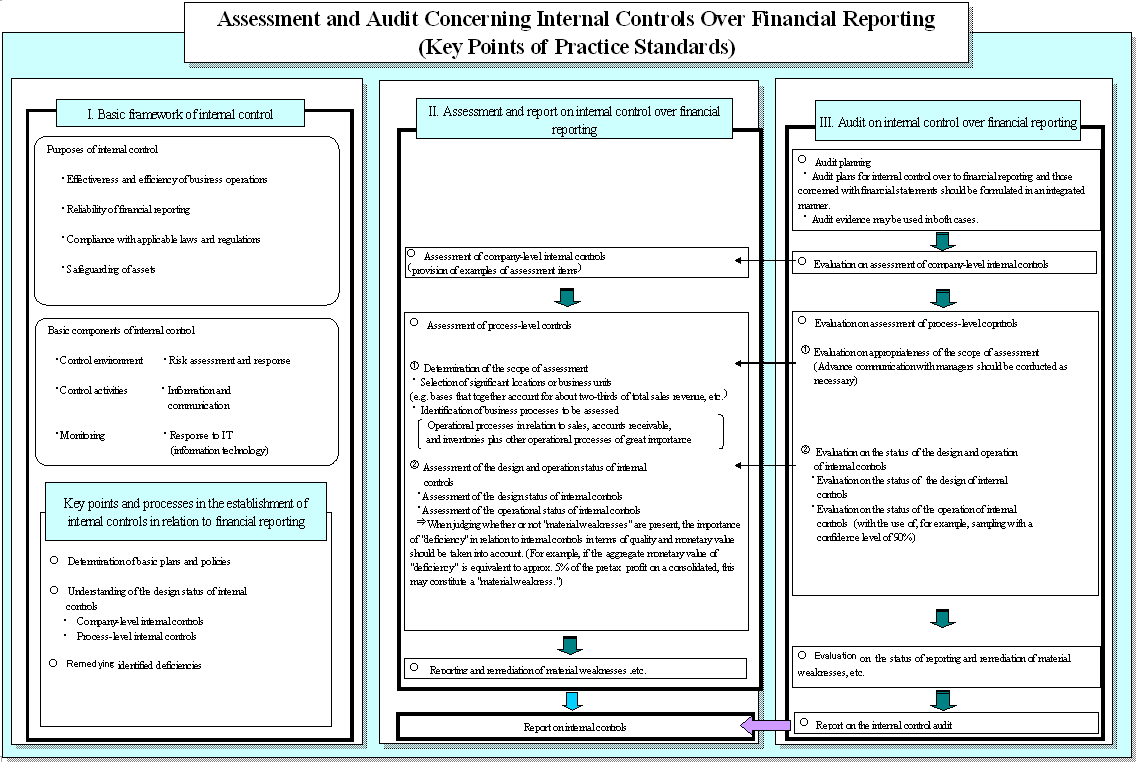
Site Map
- Press Releases & Public Relations
- Press Releases
- Press Conferences
- Official Statements
- FSA Weekly Review & ACCESS FSA
- Speeches
- For Financial Users
- Others
- Archives
- Laws & Regulations
- Name of Laws and Regulations(PDF)

- Recent Changes (Legislation, Ordinances, Guidelines)
- Guidelines
- Financial Instruments and Exchange Act
- Financial Monitoring Policy
- Public Comment
- No-Action Letter System
- Procedures concerning Foreign Account Management Institutions

