




 |
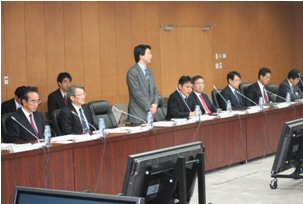 |
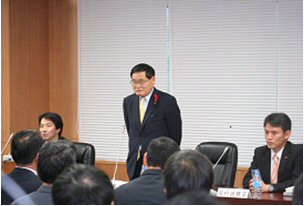
| Meeting to exchange views with inspectors(October 16) | Meeting of Directors-General of Local Finance Bureaus (October 28) |
*Please note that not all items, including regulations and articles posted on the website, have been translated into English. Therefore some of the items that are mentioned in the following articles may not be translated fully into English.
[Topics]
“Comprehensive Measures to Facilitate Financing for Small and Medium-Sized Enterprises (SMEs), etc.” (September 29, 2009)
As Japan continues to experience a severe economic and financial situation and harsh job environment, based on the recognition that a policy response has been needed for corporate finance, on September 29, the Financial Services Agency (FSA) announced that it would examine countermeasures for credit crunch and credit withdrawal. Subsequently, based on interview to various economic groups and the financial industry, and necessary review process, the FSA compiled the “Comprehensive Measures to Facilitate Financing for Small- and Medium-Sized Enterprises(SMEs), etc.” in October.
The centerpiece of the comprehensive measures is the “Bill concerning Temporary Measures for Facilitating the Financing for SMEs, etc.” (SME Finance Facilitation Bill), which was submitted to the Diet on October 30. The measures include other various measures designed to ensure the effectiveness of this bill.
A more detailed description of the measures is as follows.
1. Enactment of the SME Finance Facilitation Bill
Under the bill, first of all, financial institutions* wherever possible, strive to take appropriate steps, such as revising the loan terms, when requested by an SME or by residential mortgage borrower. Furthermore, financial institutions wherever possible, to take appropriate steps, such as revising the loan terms when requested, while cooperating with other financial institutions, government-related financial institutions, Credit Guarantee Corporations, the Enterprise Turnaround Initiative Corporation of Japan and other institutions that provide support to SMEs.
*banks, SHINKIN banks, credit cooperatives, labor banks, agricultural cooperatives, fisheries cooperatives and their federations, and the NORINCHUKIN Bank.
In order to increase the effectiveness of the responsibilities of financial institutions, under the bill, they would be obliged to develop internal systems, disclose the status of developed internal system and information on implementation such as revision to loan terms, and to make regular reports to the supervisory agencies. Furthermore, the authority will summarize and publish the reports received from financial institutions, and they would be required to devise measures for the appropriate administration of the “Act on Special Measures for Strengthen Financial Functions” and for the enhancement of credit guarantee systems.
2. Inspection/supervisory measures
In order to ensure the effectiveness of the SME Financing Facilitation Bill, in line with enforcement of laws, the FSA intends to make necessary revisions to the inspection manual and supervisory guidelines, for instance, further expanding the necessary conditions by which a loan does not fall under the category of a non-performing loan even if revision are made to its terms.
Also as part of its inspection and supervisory administrative work, the FSA intends to focus on checking the efforts of financial institutions to finance to SMEs and to provide support for management improvement of SMEs.
3. Other measures
In addition to the measures outlined above, the idea is also examined to request that government-related financial institutions, which are not targeted by the bill, should also make efforts based on the intention of the act to strive to revise the loan terms. The FSA is also considering the idea of holding face-to-face meetings to exchange opinions between FSA officials and local SMEs.
With the SME Finance Facilitation Bill being promptly passed and coming into force, and with the comprehensive measures being implemented swiftly and appropriately, the FSA will continue its efforts so that all citizens of Japan can see out the year with peace of mind.
*further details, please refer to FSA-related bills submitted at the 173rd session of the Diet (Bill concerning Temporary Measures for Facilitating the Financing of Small- and Medium-Sized Enterprises, etc.) (submitted October 30, 2009) (October 30) under the ”Bills submitted to the Diet” section of the FSA website. (please note that some of the materials are not fully translated into English).
Exposures of Japanese deposit-taking institutions to subprime-related products and securitized products
On September 11, 2009, the Financial Services Agency (FSA) summarized and published the exposures of Japanese deposit-taking institutions to subprime-related products as of June 30, 2009 and their exposures to securitized products based on the leading disclosure practices summarized in the FSF report.
As of June 30, subprime-related products held by all Japanese deposit-taking institutions totaled 407 billion yen (down 42 billion yen compared to March 31), and the cumulative total of their valuation losses and realized losses amounted to 1,110 billion yen (1,094 billion yen as of March 31).
Meanwhile, as of June 30, their total exposure to securitized products stood at 17,949 billion yen (down 534 billion yen compared to March 31), and the cumulative total of their valuation losses and realized losses amounted to 3,142 billion yen (3,302 billion yen as of March 31). Since the end of March, the cumulative total of the valuation losses and realized losses on all securitized products decreased by approximately 16 billion yen.
While there are various possible factors underlying why losses on securitized products decreased overall, three apparent reasons are that financial institutions have proceeded to account for impairments and sold securitized products markets are in the process of improving, and valuation losses have been reduced due to the effects of foreign exchange.
Since September 2007, the FSA used a uniform set of standards to publish the exposures of Japanese deposit-taking institutions to subprime-related products and securitized products.* We believe that efforts like this help promote a precise understanding of how the turmoil in the global financial markets (triggered by the subprime mortgage problem) is impacting on Japan's financial system through securitized products.
The FSA will continue its efforts to publish information, and we will continue to make environmental improvements so that the public can more easily access the current state of the Japanese financial system and the approaches to financial administration.
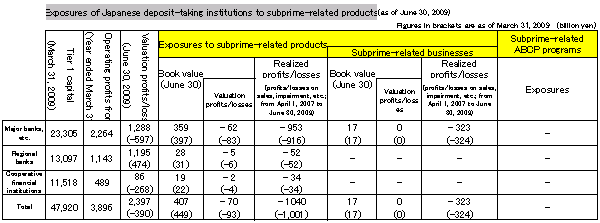
Note 1: “Subprime-related products” are asset-backed securities (ABSs) backed by subprime loans or collateralized debt obligations (CDOs) and other financial products referencing these ABSs. The above figures do not include the exposures to subprime-related products through investment trusts. “Subprime-related businesses” are the businesses in which firms produce subprime-related products.
Note 2: “Major Banks, etc.” include major banks, Norinchukin Bank, Shinsei Bank, Aozora Bank, Citibank Japan, new types of banks, foreign trust banks and others.
Note 3: “Cooperative Financial Institutions” include Shinkin Banks including the Shinkin Central Bank, Credit Cooperatives including The Shinkumi Federation Bank, Labor Banks including The Rokinren Bank, Prefectural Banking Federations of Agricultural Cooperatives, and Prefectural Banking Federations of Fishery Cooperatives. This does not include Japan Agricultural Cooperatives, etc. The Norinchukin Bank is included in "Major Banks, etc."
Note 4: The above figures are based on interviews with individual institutions, etc., and thus can be further revised in the process of examination by each institution.
Note 5: Subprime-related exposures at some securities firms are included in the figures for “Major Banks, etc.” as those figures are on a consolidated basis.
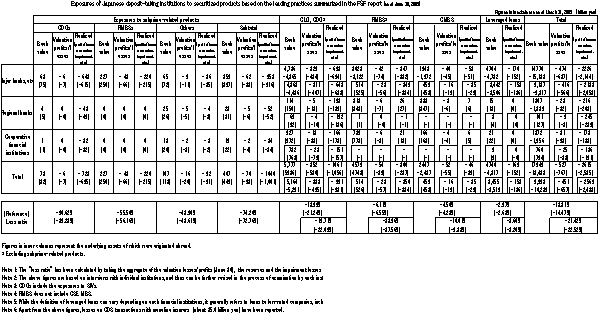
*For further details, please refer to Exposures of Japanese deposit-taking institutions to subprime-related products and securitized products (September 11, 2009) in the “Press Releases” section of the FSA website.
The revised Certified Public Accountants Act, which became effective in April 2008, introduced notification requirements for foreign audit firms, etc. (firms), which audit and attest annual securities reports and so forth submitted by foreign companies, etc. listed in Japan, to Japanese authorities. Under the revised act, administrative actions such as instruction, mandatory collection of reports and on-site inspection, etc. were also introduced.
The Financial Services Agency (FSA) and the Certified Public Accountants and Auditing Oversight Board (CPAAOB) posted the “Draft Framework for Inspection/Supervision of Foreign Audit Firms, etc.” for public consultation, for the purpose of establishing specific procedures and points of concern for the inspection and supervision of firms. On September 14, 2009, the FSA and the CPAAOB published “A Framework for Inspection/Supervision of Foreign Audit Firms, etc.”
« Outline of framework »
○ Basic inspection/supervision framework
In cases where (a) audit and public oversight systems in the firms' home jurisdictions are equivalent to those of Japan, (b) necessary information can be provided from the foreign competent authorities through appropriate arrangements of information exchange, and (c) reciprocity is ensured, the FSA and the CPAAOB will, in principle, rely on information gathering and inspections conducted by the foreign competent authorities, and will not seek to obtain information from or conduct inspections on firms themselves.
○ Operation of inspection/supervision
In cases where the above conditions cannot be met and thus the framework of mutual reliance cannot work, the FSA and the CPAAOB will seek to obtain information from or conduct inspections on firms on their own:
- Information submission: In addition to information submitted through notification documents, the CPAAOB, having notified the foreign competent authorities, will require firms to submit information that is deemed necessary, in principle, once every three years.
- Selection of firms to be inspected: The CPAAOB will analyze the information submitted and make assessment on the need for further examination on aspects including whether firms properly conduct services corresponding to audit and attestation services. Inspections will be conducted of the firms selected as the result of such assessment.
- Implementation of inspection: The CPAAOB will, in principle, notify the foreign competent authorities of its intent to conduct inspections, before it notifies the firms. With regard to specific audit engagements, the CPAAOB will limit the scope of inspection to those related to the financial statements required to be submitted pursuant to Japan's Financial Instruments and Exchange Act. In conducting inspections of operation control systems and so forth, the CPAAOB will strive for greater efficiencies in inspections and will strive to lessen the burden on firms.
- Provision of inspection reports and follow-up: The CPAAOB will notify the results of the inspection using the Japanese original, and will attach an English translation for reference. Furthermore, the FSA will, in principle, require the inspected firms to submit business improvement plans concerning any issues pointed out in the inspection results, and it will monitor the progress of improvements and provide instructions if necessary and appropriate.
- Administrative actions: In cases such as where it is deemed that the firms' conduct of services recognized as being equivalent to audit and attestation services is considerably inappropriate, the FSA will, in principle, having notified the said foreign competent authorities, issue a business improvement instruction to the firms.
*For further details, please refer to CPAAOB and FSA Publishes “A Framework for Inspection/Supervision of Foreign Audit Firms, etc.” in the “Press Releases” section of the FSA website.
Site Map
- Press Releases & Public Relations
- Press Releases
- Press Conferences
- Official Statements
- FSA Weekly Review & ACCESS FSA
- Speeches
- For Financial Users
- Others
- Archives
- Laws & Regulations
- Name of Laws and Regulations(PDF)

- Recent Changes (Legislation, Ordinances, Guidelines)
- Guidelines
- Financial Instruments and Exchange Act
- Financial Monitoring Policy
- Public Comment
- No-Action Letter System
- Procedures concerning Foreign Account Management Institutions

