



[Explanations of Laws and Regulations]
The “Cabinet Office Ordinance on Partial Amendment of the Cabinet Office Ordinance on Disclosure of Corporate Information, etc. (2010 Cabinet Office Ordinance No.12)” (referred to as “Amended Ordinance”) concerns full disclosure of corporate governance of listed companies. This was proclaimed and put into effect on March 31 this year (2010).
I. Full Disclosure of Corporate Governance
Domestic and foreign investors are very interested in corporate governance. It is considered to be important information for investors making investment decisions. Therefore, listed companies are to provide more complete content in their “Situation of Corporate Governance” required to be disclosed in securities reports.
The corporate governance of listed companies was also discussed by the Finance Council’s study group on the internationalization of Japan’s financial and capital markets, which was put in the report “Towards Stronger Corporate Governance of Listed Companies, etc.” published on 17 June 2009. Considering discussions with and items pointed out by domestic and foreign market participants, to enhance information disclosed on corporate governance of listed companies, amendments were made to the Cabinet Office Ordinance on Disclosure of Corporate Information, etc. (hereafter, “Disclosure Ordinance”). Specifically, in securities reports etc., it requires disclosure of detailed information on “Remuneration of Directors and Statutory Auditors”, “Structure of Corporate Governance” and “Shareholding Situation” (Disclosure Ordinance, Form No. 2). In temporary reports, it requires disclosure of detailed information in “Voting results” (Disclosure Ordinance, Article 19, Paragraph 2, No.9-2).
Note that this enhancement of disclosure on corporate governance applies to listed companies.(Note 1) Unlisted companies are to continue disclosure as before.
II. Structure of Corporate Governance
1. Previously, the governance system was an item written in the securities report. This amendment added the following items.
[1] Outline of corporate governance system, and reasons for adopting this system.
[2] Organization of internal audits and of audit officer (audit committee) audits, staff (if audit officers or audit committee members have significant knowledge of finance and accounting, then information on that), and procedures.
[3] Functions and roles of external directors and external audit officers (Considering independence of external directors or external auditors from the company).
etc.
(Disclosure Ordinance, Form No.2, Note on Text (57) a (a) to (c))
2. Application
“Notes on Text” for the Structure of Corporate Governance shall be applied starting with the securities report for business years ending on or after March 31 2010(note 2) (Amended Ordinance, Supplementary Provisions, Article 2, Paragraph 2. Hereafter, description about application is for securities reports.).
III. Remuneration of Directors and Statutory Auditors
1. Personnel and compensation are important elements for shareholders and other investors in a listed company to actually evaluate the company’s corporate governance. Of these, specific information on Remuneration of Directors and Statutory Auditors is important information for investment decisions and governance, from the perspectives of whether compensation matches the performance of the company or individual officers, is appropriate as incentives for individual officers, whether corporate governance is warped, etc. Thus its disclosure is required in securities reports, etc. “Compensation, etc.” subject to disclosure is economic benefit received from the company for execution of their duties as officers. Compensation etc. subject to disclosure includes both compensation already received in that business year, and amounts clearly expected to be received in that business year (excluding items previously disclosed).
The following are specific items to write (Disclosure Ordinance, Form No.2, Note on Text (57) a (d)).
(1) Disclose the total compensation etc. for each of four categories: directors other than external directors, audit officers other than external audit officers, executive officers, and external officers (external directors and external audit officers). Disclose the amounts by each compensation type (by basic compensation, stock options, bonuses, retirement benefits, etc.).
(2) For each officer, individually disclose the total amount and amount by each type of compensation etc. as an officer of the submitting company, and if simultaneously serving as officers of major consolidated subsidiaries then their compensation as officers of those consolidated subsidiaries. People subject to disclosure can be limited to people with total compensation etc. of 100 million yen or more as officers of the submitting corporation and its major subsidiaries. Also, if there are employees who simultaneously serve as officers, if the employee salary portion is important, then disclose its content.
(3) As of the submission date of the securities report etc., write the amounts of Remuneration of Directors and Statutory Auditors etc., and if there is a policy for deciding its calculation method, write the content of that policy on the securities report submission date and the policy’s decision method.
2. Application
Disclosure of Remuneration of Directors and Statutory Auditors etc. shall be applied to a securities report for a business year ending on or after 31 March 2010 (Amended Ordinance, Supplementary Provisions, Article 2, Paragraph 2). For clearly expected amounts of compensation etc. to be received in business years ending before March 2010 (for example, amount of retirement benefit reserves accrued in the year ending March 2009), it is not necessary to disclose these in securities reports for business years ending on or after March 2010.
IV. Shareholding Situation
1. There are opinions that shareholdings by the company have positive significance in business relations such as developing and maintaining business relations, and cannot necessarily be positively handled in financial statements, but there are also opinions that some cannot be considered efficient investments and can be positively handled in financial statements. Considering this situation, active disclosure of the significance of company shareholdings could be useful for investment decisions, so for shares classified as investment securities, information corresponding to holding aim is required to be disclosed in securities reports etc., as follows.
(1) Shares Held with Policy Investment Aims
[1] Total Value Disclosure
Of the shares which correspond to “Investment Securities” recorded in the balance sheet for that business year, for those with aims for holding other than purely investment aims, disclose the number of issues and total amount recorded in the balance sheet.
“Purely Investment Aims” signifies the aim is to obtain profit only by variation in values of shares and receiving dividends. This is an issue of the company’s perspective, and more specific details, standards and management is according to management decisions of each submitting company.
[2] Disclosure by Issue
For (a) the shares corresponding to investment securities held for other than purely investment aims, of those issues which are listed on domestic or foreign financial product exchanges (hereafter referred to as “Specified Investment Shares”), and (b) listed issues “Regarded as Holding Shares”, for issues with an amount recorded in the balance sheet by issue exceeding 1% of capital (if that number of issues is less than 30 issues, corresponding to the top 30 issues by amount recorded in the balance sheet) in that business year and the previous business year respectively, classify them into Specific Investment Shares vs. Regarded as Holding Shares, and disclose the issue, number of shares, amount recorded in balance sheet, and specific holding aim.(Note 3)
In writing the holding aim, generally, instead of for example writing “policy investment aim” to show the aim is other than purely for investment, it is appropriate to specifically write what the policy investment aim is.
“Regarded as Holding Shares” signifies shares for which the submitting company does not have ownership rights, but retains voting rights exercise authority or instruction authority. This amount recorded in the balance sheet shall be the business yearend price of the Regarded as Holding Shares, multiplied by the number of shares.
(2) Shares Held with Purely Investment Aims (Note on Text (57) a (e) iii)
[1] The submitting company classifies investment shares held for purely investment aims into listed shares vs. unlisted shares, then writes the amounts recorded in the balance sheet in that business year and the previous business year, and the dividends received, gain/loss on sales and valuation gain/loss in that business year.
[2] If there are issues for which the holding aim changed in that business year from purely investment aim to other than purely investment aim, or from other than purely investment aim to purely investment aim, then classify these into each of these two directions of change, and for each issue, write the issue name, number of shares, and amount recorded in the balance sheet.
(3) If the Submitting Company is a Holding Company
If the submitting company is a holding company (company whose main business is performing business management of subsidiaries), then out of the submitting company and consolidated subsidiaries, disclose items (1) and (2) for the company (referred to as “Largest Shareholding Company”) with the largest amounts of investment shares recorded in the balance sheet (referred to as “Investment Shares Recorded Amount”).
If the Investment Shares Recorded Amount of the Largest Shareholding Company does not exceed two-thirds of the amount recorded in the consolidated balance sheet for shares which are investment securities in the consolidated balance sheet of the submitting company, then disclose items (1) and (2) for the company with the next largest Investment Shares Recorded Amount among the submitting company and consolidated subsidiaries (however, for the top 10 issues instead of the top 30 issues).
If the submitting company does not correspond to a Largest Shareholding Company, then disclose items (1) and (2)for the submitting company (however, for the top 10 issues instead of the top 30 issues).
2. Application
For disclosure of the shareholding situation, consider the administrative burden on the listed company, and implement transitional measures.
(1) For the total amount of shares held for policy investment aim (in 1.(1)[1] above), apply starting with the securities report for a business year ending on or after 31 March 2010 (Amended Ordinance, Supplementary Provisions, Article 2, Paragraph 2).
(2) For disclosure by issue of shares held for policy investment aims (in 1.(1)[2] above), do according the following description (for Regarded as Held Shares, applies starting from March 2011 securities reports).
A. Listed Companies Other than Banks or Insurance Companies
[1] For March 2010 yearend security reports, write issues with an amount recorded in the March 2010 yearend balance sheet which exceeds 1% of the capital (if this is less than 10 issues, then those corresponding to the top 10 issues in terms of amounts recorded in the balance sheet). (Amended Ordinance, Supplemental Provisions, Article 2, Paragraph 3)
[2] This provision applies starting with March 2011 yearend security reports. For the previous period portion (March 2010 yearend), write the issues of [1] (Amended Ordinance, Supplemental Provisions, Article 2, Paragraph 4).
B. Banks and Insurance Companies
[1] For the March 2010 yearend security report, write the top 10 issues in terms of amounts recorded in the March 2010 yearend security report balance sheet. If the Largest Shareholding Company is not the submitting company, then instead of writing the submitting company’s top 10 issues, write the top 10 issues of that Largest Shareholding Company (Amended Ordinance, Supplemental Provisions, Article 2, Paragraphs 5 & 6). In this case, also write the items of 1.(1)[1] and (2) for that Largest Shareholding Company (also write the items of 1.(1)[1] and (2) for the submitting company).
[2] Starting with March 2011 yearend security reports, write the issues with amount recorded in the balance sheet of the March 2011 yearend security report which exceeds 1% of the capital (maximum 50 issues) (if this is less than 30 issues, then write those corresponding to the top 30 issues in terms of the amount recorded in the balance sheet). If the Largest Shareholding Company is not the submitting company, then instead of writing for the submitting company, write the issues with amount recorded in the balance sheet of the March 2011 yearend security report which exceeds 1% of the submitting company’s capital (maximum 50 issues) (if this is less than 30 issues, then write those corresponding to the top 30 issues in terms of the amount recorded in the balance sheet) (Amended Ordinance, Supplementary Provisions, Article 2, Paragraph 7). In this case, write the items of 1.(1)[1] and (2) for that Largest Shareholding Company (also write the items of 1.(1)[1] and (2) for the submitting company). Also, for the previous period’s portion, write the 10 issues of [1] (Amended Ordinance, Supplementary Provisions, Article 2, Paragraph 7).
[3] These provisions (March 2012 yearend only) apply starting from March 2012 yearend securities reports etc. For the previous period’s (March 2011 yearend) portion, write the issues of B (Amended Ordinance, Supplementary Provisions, Article 2, Paragraph 8).
(3) For disclosing total amount of shares held for purely investment aim (in 1. (2) above), this is applied starting with the securities report for a business year ending on or after 31 March 2010 (Amended Ordinance, Supplementary Provisions, Article 2, Paragraph 2).
(4) The provisions for if the submitting company is a holding company (in 1.(3) above) apply starting from securities reports with a March 2011 yearend for companies other than banks or insurance companies; they apply starting from securities reports with a March 2012 yearend for banks and insurance companies(Amended Ordinance, Supplementary Provisions, Article 2, Paragraph 9. However, for the March 2010 and March 2011 securities reports of banks and insurance companies, transitional measures are established as per (2) B [1] and [2] above).
V. Voting results
1. Considering the characteristic of listed companies, for which the shareholders’ positions are traded daily and fluctuate in the markets, disclosure to shareholders of the voting results at the shareholders general meeting can be considered important for a listed company’s governance. Consequently, from the perspectives of further clarifying shareholder intent, and with the expectation of appropriate disciplinary effects on management via the market, it shall disclose results of voting.
Specifically, disclose the following items in temporary reports (Disclosure Ordinance, Article 19, Paragraph 2, No.9-2).
[1] Dates the general shareholders meetings were held.
[2] Content of resolution items
[3] Number of voting rights which voted for, against or abstained from resolution items, requirements for passage of those resolution items, and voting results.(Note 4)
[4] Reasons that part of the number of voting rights of shareholders who attended the general shareholders meeting was not included in the number of voting rights in [3] (If requirements for passage were met by counting the portion exercised the previous day and the portion of large shareholders attending that day, and the resolution lawfully passed under the Companies Act, thus part of the voting rights were not counted, etc.)
Considering that it is actually common that some of the voting rights of attending shareholders (including the portion previously exercised, electronic voting portion, and proxy exercised portion) are not counted, it is now required to write in temporary reports the reasons that part of the number of voting rights was not included in calculating the number of voting rights which voted for, against or abstained (for example, requirements for passage were met by counting the portion exercised the previous day and the portion of large shareholders who attended the general shareholders meeting, and the resolution lawfully passed in accordance with the Companies Act, thus part of the voting rights were not counted, etc.).
2. Application
Disclosure of Voting results shall be applied starting from annual shareholders meetings for the business year ending on 31 March 2010, and to all annual shareholders meetings and extraordinary shareholders meetings held on or after such annual shareholders meetings (Amended Ordinance, Supplementary Provisions, Article 2, Paragraph 1).
(Note 1) A listed company differs from an unlisted company in that the positions of its owners the shareholders are traded in markets, thus stronger accountability to general investors may be needed regarding corporate governance.
(Note 2) For securities registration statements, in financial statements of business years ending on or after 31 March 2010, this shall apply to all securities registration statements which must be written as financial statements of the most recent business year.
(Note 3) Information of “Shareholding Situation” may partially duplicate information in the “Securities Statement” which is an attached statement of the financial statements, but the purpose of “Shareholding Situation” information is completely different from that of the “Securities Statement” which aims to complement the balance sheet. While this is disclosed as non-financial information, disclosure of the “Securities Statement” shall be continued.
(Note 4) Disclosure of the number of votes obtained for proposed resolutions to appoint each individual officer shall be written the same way as for other proposed resolutions.
*For further details, please refer to the Publication of plan to proclaim the “Cabinet Office Ordinance on Partial Amendment of the Cabinet Office Ordinance on Disclosure of Corporate Information, etc.” (March 21, 2010), in the Press Releases section of the FSA website. (In Japanese only)
Partial Revision of Comprehensive Guidelines for Supervision of Financial Instruments Business Operators, etc.
Regarding the “Partial Revision of Comprehensive Guidelines for Supervision of Financial Instruments Business Operators, etc. (Draft)”, the Financial Services Agency widely solicited opinions from December 25, 2009, to January 25 2010. Public comment results were published on March 4, 2010, and the guidelines for supervision were partially revised.
The following is an outline of the revision.
1. Outline of Revision
- (1) For Financial Instruments Business Operator Groups which Operate Internationally
For large financial instruments business operator groups which perform complex operations, the concentration of risks increases the potential risks for the financial system. Meanwhile, especially for groups working internationally, their huge size and vertical divisions in organizations make it more complex to manage the entire group, and the locations of risks to the entire group are also becoming unclear.
Consequently, for financial instruments business operator groups which work internationally, considering international discussions of the need to strengthen risk management of entire groups, for the following items, a management system is required which handles the group’s huge size, more complex operations, and international expansion progress.
[1] Business Management
- Clarification of management policies and business plans based on the overall vision the group should aim for, making these known in overseas locations, and verification of the operation situation.
- The entire group’s operation and financial details, appropriate understanding of the risk situation, and execution of required responses, including overseas locations.
- Clarification of responsibility allocation, for direct management by the business management company, appropriately combined with granting authority to overseas locations. Etc.
[2] Suitability of Operations (system of compliance with laws and ordinances, etc.)
- Establishment of system of compliance with laws and ordinances, etc., and verification of the operation situation, including overseas locations.
- Appropriate exhibition of restriction and monitoring functions for sales units etc., including overseas units. Etc.
[3] Suitability and Sufficiency of Shareholders’ Equity
- Calculation and reporting of consolidated capital-adequacy ratio based on securities rules. Selective application of Basel II is also approved.
- In that case, handle according to the third pillar of Basel II (disclosure). Etc.
[4] Risk Management System (especially, integrated risk management system, liquidity risk management system)
- Response according to the second pillar of Basel II (supervisory review).
- Appropriate handling in cases of replacing accounts between locations
- Appropriate liquidity risk management (content in accordance with the Basel Committee). Etc.
[5] Compensation Structure
- Roles of compensation committee, etc.
- Consistency of compensation structure with risk management, etc.
- Disclosure on design and operation of compensation structure.
- (2) Japanese Location of a Foreign Group
For a foreign group such as a holding company, if problems appear in business management and risk management performed by the group headquarters etc, there is also the danger of direct effects on the financial instruments business operator which is that group’s Japanese location.
Consequently, also for the financial instruments business operator which is the Japanese location of a foreign group such as a holding company, in order to ensure consistency with financial instruments business operator groups which work internationally, it was decided to revise this to comply with (1) above.
- (3) Other
Considering recent changes in the environment concerning financial and capital markets, the following revisions were made.
[1] To strengthen collection of basic information on a wide range of funds, subject business operators and items of the fund monitoring survey were added.
[2] The Law to Partially Amend the Financial Instruments and Exchange Law (enacted June 17, 2009) resulted in the introduction of separate management obligations for securities related OTC derivative (CFD) transactions, determining the points to observe under supervision in accordance with currency-related OTC derivatives (FX) transactions.
[3] Regarding IT systems etc., which act as an agent outside an auction market for two customers’ orders (buy/sell), arrangements concerning correspondence to PTS were specified.
[4] Added points to observe under supervision for business continuity management (BCM) of an investment trust management company.
[5] Specified points to keep in mind for supervision of the necessity of a permit for simultaneous business, in cases where a real estate related fund management business invests in real estate under its own account.
[6] Determined the response in case a No. 2 financial instruments business operator or investment advisory/agency business operator not subject to monitoring for minimum net asset regulations and capital-adequacy regulations has been found in danger of becoming unable to meet payments due to excess debt, etc.
[7] Changed to strengthen the supervisory response in case of finding danger of doing financial instruments and exchange business while unregistered.
2. Application Period
Of the revised supervisory guidelines, those concerning securities related OTC derivatives (CFD) transactions shall apply starting on April 1, 2010; others shall apply starting on March 4, 2010.
*For further details, please refer to the Results of public comments on “Partial Revision of Comprehensive Guidelines for Supervision of Financial Instruments Business Operators, etc. (Draft)” (March 4, 2010), in the Press Releases FSA website. (In Japanese only)
The Financial Services Agency widely solicited opinions on the “Partial Revision of Comprehensive Guidelines for Supervision of Major Banks, etc. (Draft)” from December 25, 2009, to January 25, 2010. On March 4, 2010 it published the results of public comments, and partially revised the supervisory guidelines.
The following is an outline of the revision. The revised supervisory guidelines have applied since March 4, 2010.
● Revisions considering international discussions about financial institutions
From the perspectives of international discussions about the compensation structure of financial institutions, and ensuring the suitability of operations in Japanese locations of foreign groups, it was decided to require the building of appropriate management systems for the following items.
[1] Compensation Structure
- Roles of compensation committee, etc.
- Consistency of compensation structure with risk management, etc.
- Disclosure on design and operation of compensation structure.
[2] Supervision of Branches of Foreign Banks
- Overall group management policy and business plan etc. made by the head office etc., clarification of the position of branches in the group, and consistency of operations
- Branches’ operations and finance, suitable understanding of situation of risks faced by the branches, and execution of responses as necessary
- Establishment of legal compliance system in branches, verification of operation situation
- Appropriate handling of accounts for transactions in which multiple group locations participate
- Ensuring and verification of appropriate internal audits of head offices, etc or branch.
- Compensation structure
*For further details, please refer to the Results of public comments on “Partial Revision of Comprehensive Guidelines for Supervision of Major Banks, etc. (Draft)” (March 4, 2010), in the Press Releases section of the FSA website. (In Japanese only)
Regarding the “Partial Revision of Comprehensive Guidelines for Supervision of Insurance Companies (Draft)”, the Financial Services Agency widely solicited opinions from December 25, 2009 to January 25, 2010. Public comment results were published on March 4, 2010, and the guidelines for supervision were partially revised. The revised supervisory guidelines were applied starting the same date.
The following is an outline of the revision, and major opinions.
1. Outline of Revisions
Considering international discussions of the design and operation of the compensation structures of financial institutions, the following points to observe for observation concerning the compensation structure of insurance companies etc. which have overseas locations
- Roles of compensation committee, etc.
- Consistency of compensation structure with risk management, etc.
- Disclosure on design and operation of compensation structure.
2. Major Opinions
There were many opinions (5) about the meaning and interpretation concerning the consistency of the compensation structure with risk management, and also an opinion about cooperation with overseas authorities (1).
* For further details, please refer to the Results of public comments on “Partial Revision of Comprehensive Guidelines for Supervision of Insurance Companies (Draft)” (March 4, 2010), in the Press Releases section of the FSA website. (In Japanese only)
Comprehensive Guidelines for Supervision of Financial Instruments Business Operators, etc. (Supplement) Guidelines for Supervision of Credit Rating Agencies
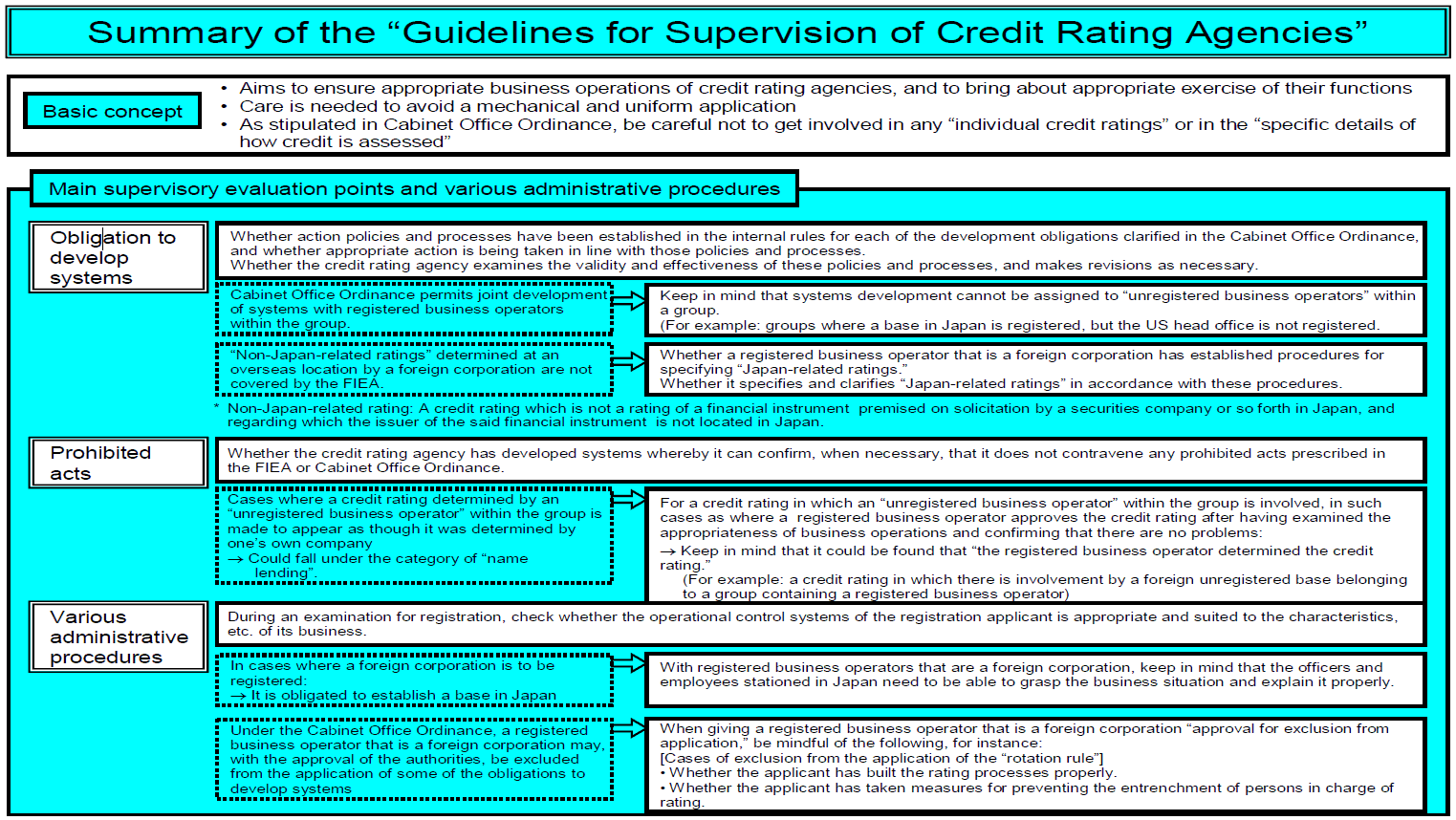
The Act to Partially Amend the Financial Instruments and Exchange Act (enacted June 17, 2009) came into force on April 1. With the start of ratings company regulations, on March 31 the Financial Services Agency determined and published the “Comprehensive Guidelines for Supervision of Financial Instruments Business Operators, etc. (Supplement) Guidelines for Supervision of Credit Rating Agencies”. The following is an outline of these supervisory guidelines.
Note: Ratings companies which registered with the authorities are called “Credit Rating Agencies”.
- 1. Basic Concept
The purpose of supervising credit rating agencies is to ensure the appropriate business operations of credit rating agencies, and to bring about the appropriate exercise of their functions.
On the other hand, concerning the regulation of credit rating agencies, given that a credit rating is an opinion expressed about an indefinite credit risk in the future based on expert knowledge, the approach that has been taken is that it would be inappropriate to make the actual substance of individual credit ratings subject to regulation. Cabinet Office Ordinance is also written so that the Commissioner of the Financial Services Agency, when exercising his/her statutory authority over credit rating agencies, should be careful not to get involved in any individual credit ratings or in the specific details of how credit is assessed. The supervisory authorities shall act while giving due consideration to this point.
Also, when applying these supervisory Guidelines, care will be taken to avoid applying the Guidelines in a mechanical and uniform fashion.
- 2. Supervisory Evaluation Points and Various Administrative Procedures
- (1) Development of Operational Control Systems
Credit rating agencies are required to develop an operational control system for the purpose of conducting their credit rating business fairly and appropriately. With regard to the items in the operational control system which are required to be provided under the Cabinet Office Ordinance, credit rating agencies need to develop a system of a certain depth and level that is appropriate to the characteristics, size, complexity and other attributes of its own business.
In the Cabinet Office ordinance, credit rating agencies that conduct business as a group are, under certain conditions, permitted to jointly develop an operational control system as a group. In such case, it should be kept in mind that no part of the operational control system can be assigned to an unregistered business operator even if it is a credit rating agency within a group.
For each item of the operational control system for which preparation is required by Cabinet Office ordinance, the credit rating agency shall use internal company rules, etc. to determine a policy for handling this, and accordingly handles this suitably. It is necessary to verify the reasonableness and effectiveness of that handling policy etc., and review it as needed.
- (2) Prohibited Acts
The credit rating agency needs to have developed systems whereby it can confirm, when necessary, that it does not contravene any prohibited acts prescribed in the Financial Instruments and Exchange Act or Cabinet Office Ordinance.
Of these, regarding the prohibition of name lending, keep in mind that even if there is a credit rating which an unregistered business operator within the group is involved in its determination, if a registered business operator approves the determination of the said credit rating, or the credit rating committee passes a resolution after having examined the appropriateness of the unregistered business operator’s operations, and confirming that there are no problems, then the registered business operator is considered to have determined the rating. Thus this does not fall under the category of name lending to an unregistered business operator within the group.
- (3) Various Administrative Procedures
During an examination for registration, it will be checked whether the operational control systems of the registration applicant is appropriate and suited to the characteristics, size, complexity and other attributes of its business.
Also, a credit rating agency which is a foreign corporation is obligated to establish a base in Japan. The officers and employees stationed in Japan need to have an appropriate understanding of the business situation of the said credit rating agency, and need to capable of properly explaining this situation to investors, etc.
Moreover, a credit rating agency that is a foreign corporation may, with the approval of the Commissioner of the Financial Services Agency, be excluded from the application of some of the obligations relating to the development of operational control systems. These supervisory guidelines provide examples of points to keep in mind for the approval.
- (1) Development of Operational Control Systems
* For further details, please refer to the Results of public comments on “Comprehensive Guidelines for Supervision of Financial Instruments Business Operators, etc. (Supplement) Guidelines for Supervision of Credit Rating Agencies (Draft)”, etc. (March 31, 2010), in the Press Releases section of the FSA website. (In Japanese only)
Site Map
- Press Releases & Public Relations
- Press Releases
- Press Conferences
- Official Statements
- FSA Weekly Review & ACCESS FSA
- Speeches
- For Financial Users
- Others
- Archives
- Laws & Regulations
- Name of Laws and Regulations(PDF)

- Recent Changes (Legislation, Ordinances, Guidelines)
- Guidelines
- Financial Instruments and Exchange Act
- Financial Monitoring Policy
- Public Comment
- No-Action Letter System
- Procedures concerning Foreign Account Management Institutions

