




 |
 |
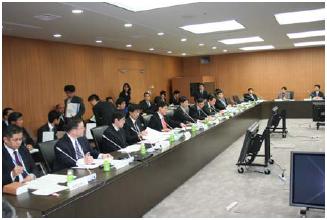
Meeting of the panel of experts on the multiple debt problem |
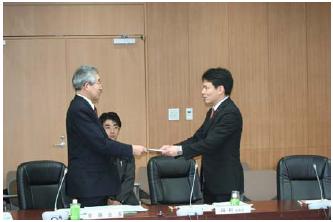
General Meeting of the Business Accounting Council |
*Please note that not all items, including regulations and articles posted on the website, have been translated into English. Therefore some of the items that are mentioned in the following articles may not be translated fully into English.
[Topics]
1. Revision History
Audit standards which are norms in doing CPA audits were revised in the past as necessary, considering international audit standards and domestic and foreign trends concerning audits. The content of the current audit standards are not inferior to international audit standards.
In international audit standards, the Clarity Project classifies all standards into required procedures and other procedures. The Clarity Project was completed in March 2009. This project focused on technical revisions to clarify text for norms in standards, but some differences arose between the post-revision international audit standards and Japan’s audit standards. This is why the Business Accounting Council (Chairman: Hideyoshi Ando, Senshu University Professor) Audit Subcommittee held on March 2, 2010 to handle revisions under the Clarity Project for international audit standards. This Subcommittee did a study focused on adjusting differences in reporting standards which specify the content etc. of opinions expressed in audit reports by auditors. On March 5, it published a public draft of revised standards and sought a wide range of opinions. It considered the opinions received, did further study, and created “Opinions on Revision of Audit Standards”, which was released at the General Meeting of the Business Accounting Council held on March 26.
2. Summary of Revised Standards
(1) Audit Reports - Content Divisions, etc.
Japan’s current audit standards divide audit reports into [1] Subject of Audit, [2] Outline of Audit Performed, [3] Responsibility of Auditors, [4] Auditor Opinion. Except for [1] Subject of Audit, it is required to assign and clearly show the title of each of these sections. Therefore also in Japan’s audit standards, audit report contents were changed from the current three divisions to four divisions, “Responsibility of Managers” and “Responsibility of Auditors” were clarified in audit reports, and each section’s content was arranged while considering the content required by international audit standards. For example, for “Managers are responsible for preparing financial statements” and “Auditor’s responsibility is to express opinion on financial statements from an independent standpoint” which are included in Subject of Audit, it was further clarified that these shall be written in sections [2] Outline of Audit Performed and [3] Responsibility of Auditors. There is also a new requirement that “Selection and application of audit procedures are decisions by the auditor” etc. be written in [3] Responsibility of Auditors section.
Also, the process itself for forming the audit opinion by auditor did not change in substance. But regarding “Opinions on exceptions” and “Limits on audit scope”, in Japan’s current audit standards, for “importance” and “breadth” which group important effects to handle them together, international audit standards clearly show two elements. This revision clarifies that for such effects, decisions shall be made from the two elements of “importance”, and “breadth” which is whether these affect the overall financial statements.
(2) Supplemental Information
In the current audit standards, apart from the auditor’s opinion, the auditor shall add as information the items it deems appropriate to explain or emphasize. There is no division between emphasis items emphasized with that text as a precondition in order to especially emphasize an item written in the financial statements, vs. explanation items written as items the auditor deems appropriate to explain; these two are specified together. In international audit standards after the Clarity Project, it is required to divide these two when writing them. Therefore also in Japan’s audit standards, it was made necessary to divide items deemed appropriate to emphasize with financial statement text as a precondition, vs. other items the auditor deems appropriate to explain.
3. Implementation Period, etc.
The revised audit standards shall be implemented starting with audits of financial statements with a closing date in March 2012. Regarding practical guidelines required for applying these revised standards to practical work, the Japanese Institute of Certified Public Accountants has been asked to urgently make these after discussions with people concerned, and following appropriate procedures. Audit reports shall be prepared in the new format starting with those with a closing date in March 2012.
*For further details, please refer to the Publication of “Opinions on Revision of Audit Standards” (March 29, 2010), in the Press Releases section of the FSA website. (In Japanese only)
The Securities and Exchange Surveillance Commission (SESC) published the “Basic Inspection Policy and Inspection Program for Business Year 2010” on April 6.
In order to orderly manage and conduct securities inspections, the SESC and the Local Finance Bureaus formulate its Basic Inspection Policy (hereafter referred to as the “Basic Policy”) and the Basic Plan, (hereafter, referred to as the “Basic Plan”) each year. The summary of Basic Policy is as follows.
In recent years, securities inspections have faced greater environmental changes, such as the sharp increase in the coverage and the number of entities subject to inspection through a series of regulatory reforms, the experience of global financial crisis, and the widespread of financial products trading through the IT system.
In order to address these changes, SESC shall carry out various efforts for efficient and effective inspection, such as, more risk-based inspection planning, introduction of advance notice inspections, enhanced cooperation with supervisory authorities, formulation and revision of inspection manuals, etc. Also, from the perspective of preventing systemic crises, the SESC will focus on verifying the appropriateness of internal control by those entities which hold important positions in the financial markets. Furthermore, from the perspective of ensuring the reliability of IT systems, the SESC will put more efforts on verifying the appropriateness of the IT risk management systems of financial instruments business operators.
In addition to these environmental changes, from an investor protection perspective based on recent inspection results, the SESC will continue to verifying the status of investor solicitation and customer care, and of explanation on risks especially those of complex structured products such as derivatives. SESC will also continue inspection on so-called fund businesses, where many major violations of laws and ordinances are currently being identified. In cases where the suspicion on conduct of unregistered businesses is to be found, the SESC will address such cases in close cooperation with investigative authorities. Furthermore, SESC will continue verifying on the exercise of their functions of gatekeepers by the entities, in the areas such as the management of their customers, trade examination, and undisclosed corporate information, etc.
From this business year, the Basic Plan begins to describe its basic concept, as well as the efforts in close cooperation with the Local Finance Bureaus.
| Type I Financial Instruments Businesses firms (including Registered Financial Institutions) and Asset Management firms | 150 firms (including 110 firms to be inspected by the Local Finance Bureaus) |
| Investment advisory firms/agencies, Type II Financial Instruments Businesses operators and financial instruments intermediaries, etc. | To be inspected on an on-going basis |
| Self-regulatory organizations | To be inspected as necessary |
(Note)The figures are subject to change due to the revision of the inspection program during this business year and/or the implementation of special inspections. |
|
The SESC will conduct securities inspections in accordance with the Basic Inspection Policy and Inspection Program, thereby continuing its efforts for ensuring fair and transparent markets and for investor protection.
*For further details, please refer to the Basic Inspection Policy and Inspection Program for Business Year 2010 , in the SESC website.
Site Map
- Press Releases & Public Relations
- Press Releases
- Press Conferences
- Official Statements
- FSA Weekly Review & ACCESS FSA
- Speeches
- For Financial Users
- Others
- Archives
- Laws & Regulations
- Name of Laws and Regulations(PDF)

- Recent Changes (Legislation, Ordinances, Guidelines)
- Guidelines
- Financial Instruments and Exchange Act
- Financial Monitoring Policy
- Public Comment
- No-Action Letter System
- Procedures concerning Foreign Account Management Institutions

