




 |
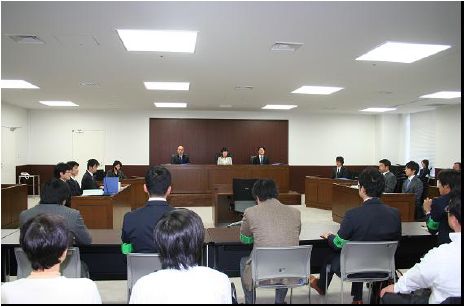
1st trial of case of false statements in annual securities reports etc. |
Featured
The New Growth Strategy (Cabinet Decision, June 18, 2010.) incorporated “Establishment of an Integrated Exchange Handling Securities and Other Financial Instruments as well as Commodities” as one of 21 National Strategic Projects. To work on project details, the FSA, the Ministry of Agriculture, Forestry and Fisheries, and the Ministry of Economy, Trade and Industry (hereinafter “Related Ministries & Agency”) submitted “This Year’s Work Timetable for the 21 National Strategic Projects” to the 2nd Meeting of the Council on the Realization of the New Growth Strategy (held October 8). This timetable clearly shows a plan to set up a forum for study in October, to publish an interim report by the end of this year, and if considered necessary on the basis of this report, to study submission of a related bill to the next ordinary session of the Diet.
Recently, the Integrated Exchange Study Team was launched as this “a forum for study”, comprised of the Senior Vice Ministers and the Parliamentary Secretaries of the Related Ministries & Agency. Based on the following basic viewpoints, it is proceeding with its study through open hearings with related parties and through exchanges of opinions. The 1st Conference was held on October 28, and this conference has been held in succession.
Viewpoints in Studying Systems and Measures to Promote the Establishment of an Integrated Exchange
1. What are specific advantages of the establishment of an integrated exchange? And how specifically would its achievement help establish Japan’s position as a main market in Asia in 2020, the target year for the New Growth Strategy?
2. Compared to 1., what are the current problems? For example, starting this year, exchanges are allowed to mutually handle securities and other financial instruments as well as commodities, to promote competition among exchanges. Why has this move not made specific progress actually?
3. What are the systems and measures to promote the establishment of an integrated exchange? In discussing this, the study will also proceed from the following viewpoints.
- What should be done to expand the participation of market participants and general investors, while protecting investors and users?
- What should be done to maintain and strengthen the international competitiveness of an exchange, as an industrial infrastructure which functions as a place for fair price formation of commodities, and for risk hedging?
*For details, please go to the FSA web site and access The Integrated Exchange Study Team Launched (October 28, 2010) from the Press Releases section. (Available in Japanese only)
Also, please access past proceedings of the study team, 2nd The Integrated Exchange Study Team (Proceedings Outline) (held November 9, 2010), and 3rd The Integrated Exchange Study Team (Proceedings Outline) (held November 19, 2010). (Available in Japanese only)
The Financial Services Agency (FSA) has studied formulation of the Action Plan for the Invigoration, etc. of Financial/Capital Markets and Financial Industry, which is an “item to be implemented in FY2010” in the timetable of the New Growth Strategy (Cabinet Decision dated June 18, 2010).
Consequently, in order to reach the stage of full scale work on formulation of the action plan, the FSA decided to publish how it would proceed, and it published the Formulation of “Action Plan for Invigoration, etc. of Financial/Capital Markets and Financial Industry” on October 8. Full scale work has now begun in accordance with published policy.
In Japan’s growth strategy, it is important that finance fulfills two roles: (1) Back up and support real economy and enterprises, (2) Lead economy as a growing industry itself.
By the end of the year, the FSA intends to formulate an action plan that summarizes the measures to be taken in the future to develop an environment for Japan’s financial sector to properly fulfill the two roles described above. The FSA will seek the opinions of interested parties in various fields as necessary, in consideration of the approach presented in the New Growth Strategy, focusing on the agendas below, while materializing the measures stated in the work schedule, and examining new measures that will similarly help bring about economic growth.
Agendas of Action Plan
(1) Appropriate supply of funds according to the company’s size and growth stage
Facilitated supply of funds for small-and medium-sized enterprises (SMEs), etc.
(such as promotion of region-based relationship banking (demonstration of value-creating financial-intermediation functions, etc.))
Appropriate supply of risk money for growing companies, etc.
(such as restoring confidence in and stimulation of markets for growing companies, etc., promotion of financial institutions’ initiatives focusing on future growth potential)
Flexible supply of funds to large companies, etc.
(such as primary and secondary markets for corporate bonds targeted at professional investors)
(2) Financial sector serving as a bridge between Asia and Japan
Expansion of Japanese financial institutions’ activities in Asia
(such as promotion of coordinated policies for financial regulations in Asian countries, and review of regulations for overseas real estate investments by insurance companies)
Establishing Japan’s status as a main financial market in Asia
(such as comprehensive exchanges handling securities and other financial instruments as well as commodities, expansion of scope of disclosures in English, drastic simplification of quarterly reports, investment management businesses targeted at professional investors, enhancement of corporate governance, and tax measures for cross-border transactions)
(3) Asset management capable of effectively utilizing nation’s assets
Development of an environment for qualified and secured asset management
(such as financial and securities tax systems (extension of reduced tax rate for securities, etc.), investment management businesses targeted at professional investors (relisted), and steady implementation of financial services Alternative Dispute Resolution (ADR) system)
Based on such work, the FSA plans to publish the examination status of the agendas at some stage, and put together an action plan after further seeking the opinions of interested parties in various fields as necessary.
Through such financial sector initiatives, the FSA intends to actively contribute to Japan’s economic growth.
*For details, please go to the FSA web site and access Formulation of “Action Plan for Invigoration, etc. of Financial/Capital Markets and Financial Industry” (October 8, 2010) from the Press Releases section.
[Topics]
Business Sentiment etc. of Small -and Medium size Enterprises (SMEs) Questionnaire Survey Results Summary
As part of its ascertaining the actual situations of small and medium enterprise finance, via financial bureaus throughout Japan, the FSA performed an interview survey which covered chambers of commerce and industry, business adviser, etc.
1. Questionnaire Survey on Business Sentiment etc. of SMEs
- The FSA performed an interview survey covering 47 chambers of commerce and industry, one for each of Japan’s prefectures. Questions included those about the current and future business sentiment and cash flow of member enterprises, currently and in the future.
| Category | Diffusion Index (D.I.) (good - bad) |
Negative factors (% of responses) | (unit: %) | |||||
| Current | Future | (1)Higher procurement prices: crude oil, raw materials prices, etc. | (2)Delays in incorporating higher costs into prices, due to relations with customers | (3)Weak sales due to weak demand | (4)Lower sales prices due to excess competition | (5)Effects of global market movements: stocks, foreign exchange, etc. | (6)Effects of stronger/ looser regulations | |
| Manufacturing | -68 (-70) |
-79 (-68) |
11.8 (13.3) |
3.1 (8.0) |
49.6 (52.2) |
19.7 (21.2) |
15.7 (5.3) |
0.0 (0.0) |
| Retail | -79 (-83) |
-81 (-83) |
3.7 (3.0) |
3.0 (3.0) |
53.7 (54.1) |
35.8 (34.8) |
2.2 (3.7) |
1.5 (1.5) |
| Wholesale | -81 (-85) |
-83 (-83) |
3.1 (5.4) |
6.2 (6.2) |
57.4 (53.1) |
29.5 (31.5) |
3.9 (3.8) |
0.0 (0.0) |
| Construction | -89 (-87) |
-87 (-89) |
7.5 (6.7) |
3.8 (4.0) |
52.5 (54.0) |
33.1 (31.3) |
0.0 (0.0) |
3.1 (4.0) |
| Services | -74 (-79) |
-74 (-77) |
5.0 (3.5) |
0.0 (1.7) |
60.0 (64.3) |
35.0 (30.4) |
0.0 (0.0) |
0.0 (0.0) |
| Real estate | -89 (-83) |
-89 (-85) |
1.8 (1.0) |
1.8 (2.0) |
74.3 (74.3) |
21.1 (22.8) |
0.0 (0.0) |
0.9 (0.0) |
| Transport | -81 (-87) |
-83 (-85) |
12.1 (22.0) |
3.2 (3.0) |
56.5 (49.2) |
26.6 (25.8) |
0.0 (0.0) |
1.6 (0.0) |
| Average | -80 (-82) |
-82 (-81) |
6.5 (8.0) |
3.1 (4.0) |
57.1 (56.6) |
29.0 (28.7) |
3.1 (1.8) |
1.1 (0.9) |
(1) Looking at business sentiment of SMEs, conditions continue to be harsh.
The most common negative factor continued to be “Weak sales,” followed by “Lower sales prices.” “Effects of market movements: foreign exchange, etc.” had a higher percent for manufacturing than in the previous survey.
Note 1: D.I. = (percent of respondents who replied “Good”) - (percent of respondents who replied “Bad”)
Note 2: Multiple replies are possible for negative factors.
Note 3: Figures in parentheses are results of the May 2010 survey.
Also looking at (2) cash flow of SMEs, conditions continue to be harsh.
“SME sales factors” was the most common negative factor.
| Category | Diffusion Index (D.I.) (good - bad) |
Negative factors (% of responses) | (unit: %) | ||||
| Current | Future | (1)SME sales factors: lower sales, long term inventories, etc. | (2)Financial institution lending attitude: loan examinations, etc. | (3)Financial institution loan terms: loan periods, repayment terms, etc. | (4)Nonbank lending attitude & trends: effects of Amended Money Lending Business Act, etc. | (5)Handling by credit guarantee corporations and government financial institutions: safety net loans, guarantees, etc. | |
| Manufacturing | -62 (-62) |
-70 (-62) |
80.6 (88.9) |
5.6 (3.2) |
5.6 (6.3) |
0.0 (0.0) |
8.3 (1.6) |
| Retail | -66 (-68) |
-72 (-74) |
77.2 (88.0) |
7.6 (2.7) |
3.8 (4.0) |
2.5 (2.7) |
8.9 (2.7) |
| Wholesale | -64 (-70) |
-70 (-70) |
79.7 (92.9) |
4.1 (2.9) |
6.8 (2.9) |
0.0 (0.0) |
9.5 (1.4) |
| Construction | -72 (-77) |
-77 (-83) |
77.0 (83.5) |
13.8 (9.4) |
3.4 (3.5) |
0.0 (0.0) |
5.7 (3.5) |
| Services | -66 (-66) |
-60 (-62) |
85.5 (87.0) |
1.4 (4.3) |
4.3 (2.9) |
2.9 (2.9) |
5.8 (2.9) |
| Real estate | -63 (-63) |
-65 (-67) |
74.3 (78.9) |
13.5 (9.9) |
8.1 (7.0) |
0.0 (1.4) |
4.1 (2.8) |
| Transport | -72 (-70) |
-70 (-72) |
76.6 (82.9) |
13.0 (7.1) |
5.2 (7.1) |
0.0 (0.0) |
5.2 (2.9) |
| Average | -66 (-68) |
-69 (-70) |
78.6 (85.9) |
8.6 (5.8) |
5.3 (4.8) |
0.8 (1.0) |
6.8 (2.6) |
Note 1: D.I. = (percent of respondents who replied “Good”) - (percent of respondents who replied “Bad”)
Note 2: Multiple replies are possible for negative factors.
Note 3: Figures in parentheses are results of the May 2010 survey.
2. Questionnaire Survey on Financial Institution Loan Trends, etc.
- The FSA performed an interview survey of 596 people, including business advisers each region’s chamber of commerce and industry and society of commerce and industry. The survey covered their evaluation of the stance regarding loans toSMEs, state of awareness of FSA policies, etc.
(1) Evaluation of stance regarding loans to SMEs.
- Active evaluations (total of the percentages who replied “Active” and “A little active”) were 65% in total for all business forms.
- Passive evaluations (total of the percentages who replied “Passive” and “A little passive”) were 10.4% in total for all business forms.

(2) Evaluation of handling of changes in terms of loans to SMEs
- Active evaluations were 65.3% in total for all business forms.
- Passive evaluations were 4.1% in total for all business forms.

(3) Situation of financial institutions’ handling of complaints and consultations concerning changes in loan terms, etc.
- Active evaluations (total of the percentages who replied “Sufficient handling” and “Generally sufficient”) were 33.9% in total for all business forms.
- Passive evaluations (total of the percentages who replied “A little insufficient” and “Insufficient”) were 4.4% in total for all business forms.

(4) Evaluation of stance in efforts to demonstrate consulting function for SMEs
- Active evaluations (total of the percentages who replied “Active” and “A little active”) were 39.6% in total for all business forms.
- Passive evaluations (total of the percentages who replied “Passive” and “A little passive”) were 15.5% in total for all business forms.

(5) Status of Awareness of FSA Policies
- Expanded handling in cases not corresponding to restructured loan: 94.8%
- Content of Financial Inspection Manual Supplement (Small and Medium Enterprise Loan Edition): 96.3%
*For details, please go to the FSA web site and access Questionnaire survey on small and medium enterprise finance Summary of results (October 1, 2010) from the Press Releases section. (Available in Japanese only)
In order to understand the situation of implementation of the Act on Protection, etc. of Depositors, regarding crime with counterfeit and stolen cash cards, crime using stolen bank book and crime using Internet banking crimes, the FSA summarized the situation of damages arising from April to June 2010, and the situation of victim compensation by financial institutions, and published the information on October 20.
Summary of Damage Occurrence Situation and Compensation Situation
(1) There were 43 cases of damage occurring due to counterfeit cash cards during the first quarter (April-June) of FY2010. There were a cumulative 3,617 cases during the subject period (April 2000 onwards). There was a 98.7% ratio of compensation by financial institutions in the subject period, on the basis of cases for which handling policy was decided.
(2) There were 1,316 cases of damage occurring due to stolen cash cards during the first quarter (April-June) of FY2010. There were a cumulative 30,997 cases during the subject period (February 2005 onwards). There was an 83.9% ratio of compensation by financial institutions in the subject period, on the basis of cases for which handling policy was decided.
(3) There were 37 cases of damage occurring due to stolen bank books during the first quarter (April-June) of FY2010. There were a cumulative 2,319 cases during the subject period (April 2003 onwards). There was a 42.1% ratio of compensation by financial institutions in the subject period, on the basis of cases for which handling policy was decided.
(4) There were 12 cases of damages occurring due to Internet banking during the first quarter (April-June) of FY2010. There were a cumulative 590 cases during the subject period (February 2005 onwards). There was an 85.2% ratio of compensation by financial institutions in the subject period, on the basis of cases for which handling policy was decided.
Note 1: For the above compensation ratios, some of the cases for which handling policy was decided were excluded. For example, cases in which there was initially an application for repayment of the damages by another person, but as a result of investigation, it was found that there was repayment by the spouse or family, not repayment for improper damages.
Note 2: These are the numbers of cases of damage reported by each financial institution by the 15th day of the month after the damages occurred, summarized in an early report of damages. Therefore, the actual numbers may vary.
Considering the diversification of crime techniques, the FSA will continue to closely monitor efforts by financial institutions, encouraging them to enhance their information security policies, and handle customers properly.
Also, many counterfeit and stolen cash card crimes etc. are still occurring, so we urge all depositors to also take crime prevention actions themselves.
*For details, please go to the FSA web site and access Situation of damage occurring due to counterfeit cash cards, etc. (October 20, 2010) from the Press Releases section. (Available in Japanese only)
Considering that malicious cases using deposit accounts are becoming a large social problem, the FSA promptly provides information on improper use of deposit accounts to the financial institutions where such accounts were opened and to police authorities, in cases where agreement is obtained from the party providing information, excluding cases deemed to be clearly lacking credibility. The number of cases of information provided is published each quarter.
According to that information, from when the surveys began in September 2003 until September 2010, the FSA and Financial Bureaus throughout Japan, etc. provided information on 29,749 cases of improper use of deposit accounts.
Also, in cases where there is information indicating improper use of deposit accounts, it is vital that the financial institution investigates immediately, thoroughly checks identity, and promptly takes action as needed: suspend deposit transactions, closing the deposit account, etc. In response to information provided by the authorities by September 30, 2010, financial institutions suspended account use in 16,048 cases, forcibly closed accounts in 11,042 cases, etc.
*For details, please go to the FSA web site and access Number of cases of information provided concerning improper use of deposit accounts (October 29, 2010) from the Press Releases section. (Available in Japanese only)
| Number of cases in information provided | Handling by financial institutions | ||||||
| In period | Cumulative | Forcibly closed account, etc. | Use suspended | Under investigation | Other | ||
| Cumulative (change) |
Cumulative (change) |
Cumulative (change) |
Cumulative (change) |
||||
| March 31, 2010 (change from January to March, 2010) |
1,274 | 27,099 | 10,220 (461) |
14,534 (739) |
494 (-29) |
1,851 (103) |
|
| June 30, 2010 (change from April to June, 2010) |
1,297 | 28,396 | 10,643 (423) |
15,264 (730) |
548 (54) |
1,941 (90) |
|
| Sept. 30, 2010 (change from July to September, 2010) |
1,353 | 29,749 | 11,042 (399) |
16,048 (784) |
576 (28) |
2,083 (142) |
|
| Major banks | 492 | 18,397 | 7,990 (205) |
9,079 (209) |
349 (38) |
979 (40) |
|
| Regional banks & banks in The Second Association of Regional Banks | 245 | 4,093 | 1,379 (36) |
2,245 (191) |
124 (0) |
345 (18) |
|
| Shinyo Kinko, credit unions | 72 | 1,180 | 548 (28) |
417 (30) |
84 (10) |
131 (4) |
|
| Other financial institutions | 544 | 6,079 | 1,125 (130) |
4,307 (354) |
19 (-20) |
628 (80) |
|
*Received at financialbureaus (branch) throughout Japan, with information provided to financial institutions (part of it includes information received at FSA) counted on a cumulative basis since these surveys began on September 16, 2003.
*Changes are the numerical differences vs. the previous quarter.
*“Other” signifies that as a result of surveys by financial institutions, no especially suspicious points were found, the account did not exist, etc.
*“Major banks” signify city banks, long term credit banks and trust banks, excluding Shinsei Bank and Aozora Bank.
*Saitama Resona Bank is included in “Regional banks & banks in The Second Association of Regional Banks.”
*“Other financial institutions” signifies banks other than major banks,as well as labor banks,regional banks and banks in The Second Association of Regional Banks, etc. Since October 2007, this includes Japan Post Bank.
*This is on an early report basis, so figures may be corrected due to careful examination.
Status of Counseling etc. Provided by the Counseling Office for Financial Services Users (Period: July 1 to September 30, 2010)
The FSA publishes quarterly information on the number of consultations for users who visited the Counseling Office for Financial Services Users (hereafter “Counseling Office”) and the main points regarding consultation topics, etc. The consultation reception situation, characteristics, etc. from July 1 to September 30, 2010 were as follows.
1. From July 1 to September 30, 2010, there were 13,480 consultations, etc. (refer to Status of counseling, etc. provided by the “Counseling Office for Financial Services Users” (period: July 1 to September 30, 2010) (October 29, 2010). On average, 214 cases were handled per day, a decrease from the results (249 cases) from April 1 to June 30, 2010 (hereafter the “Previous Period”).
2. Viewed by area, 4,599 cases (34%) were handled for deposits and financing, etc., 2,712 cases (20%) for insurance products, etc., 3,781 cases (28%) for investment products, etc., 1,966 cases (15%) for loans, etc., and 422 cases (3%) for general financial administration and other.
3. Characteristics by Area
(1) Deposits and financing, etc. decreased overall compared to the Previous Period, but there was a large increase in consultations, etc. regarding the deposit insurance system.
(2) Insurance products, etc. saw a decrease compared to the Previous Period.
(3) Investment products, etc. were at almost the same level as the Previous Period, but there was a decrease in consultations, etc. regarding unlisted stocks.
(4) Loans, etc. saw a large decrease compared to the Previous Period, partly due to a large decrease in consultations, etc. regarding total amount regulations.
4. Among the consultations handled, information* is provided which is useful for inspections and supervision. From the perspectives of protection and enhanced convenience of users overall, this is used as valuable information for financial administration, such as for interviews in verifications and supervision during inspections of financial institutions.
*Examples of Information which is Useful for Inspections and Supervision
(1) Approach in explanations to customers by a deposit handling financial institution when selling risky products, etc.
(2) Improper displays, including advertising, by a deposit handling financial institution
(3) Improper customer handling by a deposit handling financial institution
(4) A deposit handling financial institution sells financial products by using its advantageous position over borrowers
(5) Handling of collateral by the loan business of a deposit handling financial institution
(6) Handling of personal information by a deposit handling financial institution
(7) So-called credit crunch, credit withdrawal and loan condition changes
(8) Non-payment, etc. by an insurance company (neglects to pay incidental insurance payouts, non-payment of insurance payouts concerning third sector products, etc.)
(9) Improper conduct by an insurance solicitor, etc. (insufficient explanation of important matters, improper guidance and handling for procedures, undisclosed inducement, unauthorized contract, name borrowing, paying insurance premiums for another party, etc.)
(10) A non-life insurance company charging excessive insurance premiums for fire insurance
(11) Conduct which could be a legal violation by a money lending business operator (violations of collection conduct regulation, etc.)
(12) Improper explanation by a money lending business operator
(13) Information system failure
(14) Improper conduct by a foreign currency exchange business operator
(15) Internet transactions with a foreign currency exchange business operator
(16) Selling without registration
(17) Improper conduct by a financial instruments business operator (web site closed and does not answer the phone, unauthorized trading, solicitation of the elderly, etc.)
(18) Approach in explanations to customers by a financial instruments business operator when selling risky instruments, etc.
(19) Conduct which could be a legal violation using a so-called collective investment scheme
Status of activities regarding information in the previous period.
(1) In conducting interviews, etc. with the 217 financial institutions which were supervised, information received by the Counseling Office was referred to.
(2) In the inspections of 20 financial institutions performed by the FSA, information received by the Counseling Office was referred to. Also, information on improper use of 13 deposit accounts was provided to financial institutions and police authorities.
5. The FSA published examples of consultations, etc. held that users should be made aware of in Sample Consultations with Users and Advice from the Counseling Office, etc.
Below are items and counseling examples from the newly supplemented and revised Sample Consultations with Users and Advice from the Counseling Office, etc.
(1) Sample consultations with users and advice from the counseling office, etc. regarding insurance products, etc.
- Consultation regarding explanations to customers regarding insurance details, etc.
- When I requested an insurance payout, I was told that they will not pay because they are exempt from liability for it under the contract. But that was not explained to me when I signed the contract.
- I have medical insurance policies with two companies, and when I had surgery, company A made an insurance payout, but company B did not pay. But when I signed the contract, company B did not tell me that sometimes there is no insurance payout, depending on the surgery.
Consultation Examples (Insurance Details, etc.) - Supplemented/Revised
Advice, etc.
- For problems regarding individual contracts, get plenty of explanation from the insurance company, and discuss it fully with the insurance company. If that does not resolve the problem, please consult with the Life Insurance Consultation Center of The Life Insurance Association of Japan, general insurance ADR centers, etc.*
*For industry organization contact information, please refer to the Designated Dispute Resolution Institution List at the FSA web site. (Available in Japanese only)
(2) Sample consultation with a user and advice from the counseling office, etc. regarding investment products, etc.
- Consultation regarding transactions in unlisted stocks, etc.
Consultation Example (Business operator which impersonated the FSA, Financial Bureaus, etc.)
- Supplemented/Revised
- I received a phone call from a person pretending to be a member of staff at the FSA’s Counseling Office for Financial Services Users, who warned me about unregistered business operators, and told me about past unlisted stock transactions.
Advice, etc.
- The FSA etc. does not outsource any work regarding transactions in unlisted stocks, etc. Also, members of staff at the FSA and Securities and Exchange Surveillance Commission do not talk on the phone about when unlisted stocks will be listed, nor do they negotiate purchases of unlisted stocks. If you receive such communication, you should consider this a fraudulent business method and not get involved at all.
The FSA and Securities and Exchange Surveillance Commission are gathering information on business operators who impersonate the FSA and Securities and Exchange Surveillance Commission, or similar sounding organizations.
If you are contacted by such a business, please provide information to the FSA Counseling Office for Financial Services Users (from IP phone or PHS phone 03-5251-6811, Navi Dial 0570-016811) or to the Securities and Exchange Surveillance Commission information reception desk (03-3581-9909).
Also, the FSA posts information about warnings to financial services users on its web site section For the General Public.
*For details, please go to the FSA web site and access Status of counseling, etc. provided by the “Counseling Office for Financial Services Users” (period: July 1 to September 30, 2010) (October 29, 2010) from the Press Releases section. (Available in Japanese only)
Together with Local Finance Bureaus, the Securities and Exchange Surveillance Commission (SESC) has conducted intensive inspections since FY2009 on the legal compliance situation of dealers that sell equities in collective investment schemes (funds). On October 19, 2010, it summarized and published the examples of problems found in the inspections. Furthermore, based on the results of the inspections, the SESC recommended the FSA Commissioner to impose additional disclosure requirements on so-called “business funds” (funds that invest more than half of the money contributed in real businesses, rather than securities or derivatives transactions) dealers regarding account separation written on Document Prior to Conclusion of Contract.
By publishing the results, the SESC intends to ask fund dealers to comply with the laws and regulations, and to alert public investors to be well aware of the issues identified, when investing in funds.
For more details, please visit  http://www.fsa.go.jp/sesc/news/c_2010/2010/20101019.pdf on the SESC web site. (Available in Japanese only)
1. Summary of Inspection Results
The SESC found legal violations, etc. in 25 of the 35 agents inspected (about 70%), and it pointed out these problems in inspection result notices. Thus some problems were found in most of the fund sales agents. Furthermore, serious legal violations, etc. were found in 15 agents (about 40%), and the SESC made recommendations to seek administrative penalties.
(1) Main Problems
The main problems found in the inspections are as follows.
1. Inappropriate account separation between fund’s own money and investors’ (Diversion of investors’ money and unexplained expenditure)
Problematic cases include a dealer that diverted investors’ money into its debt repayments without account separation between fund’s own money and investors’, a fund dealer and manager that diverted investors’ money into its running costs, and a dealer with a huge amount of unexplained expenditure. These cases were very serious from the viewpoint of investor protection, with the customers’ money invested having been consumed for other purposes than fund management.
These misappropriations were especially remarkable in the case of “business funds”. Thus the SESC made a policy recommendation to the FSA Commissioner on October 19, as described in 2. (2) 1. below.
2. False explanation and misleading advertisements
There was a case where the fund dealer that also performed fund management signed sales contracts to gather investments, pretending that it held the fund equities although it did not actually have them. Another case was that false returns were posted on the dealer’s website despite the lack of performances that enable such returns from the business invested. These cases were very serious in terms of investor protection since false information was provided to customers to induce them to sign contracts.
3. Name-lending to a non-registered dealer
A registered fund dealer was found to be letting an illegal non-registered dealer sell fund equities under the name of the former, thus evading the registration system by engaging non-regulated firm in regulated financial activities. This case is very serious for investor protection.
4. Non-registered financial activities by fund dealers themselves
An investment advisory firm sold investors fund equities before gaining the required registration of Type II Financial Instruments Business Operator. Specially Permitted Business Notifying Firms, whose scope of operations are limited, sold investors fund equities or managed funds without satisfying the requirements of Specially Permitted Businesses for Qualified Institutional Investor. These cases demonstrate the serious problem that, by evading the business regulations, violate the law’s intent to protect public investors by the registration system.
5. Asset management that damages the benefits to the investors for the fund’s own benefit
A fund dealer and manager bought unlisted stocks from the existing stockholders at a lifted price to incorporate them into its fund, and later got a refund of part of the lifted price from them, thus damaging the interests to the fund investors. This case undermines investor protection by placing unnecessary burdens on the fund in order to obtain the dealer’s own benefit.
(2) Causes of legal violations
Looking at the causes of these problems, in almost all cases, it was found that officers of the fund dealers lacked sense of compliance, and their legal compliance systems were undeveloped.
In addition, in many cases, it was found that checks by the fund dealers of the fund managers’ operations were insufficient, given the fact that those two were identical, or were actually identical in spite of being different entities.
2. Way forward
(1) Fund dealers
Fund dealers are strongly required to be aware of their duties for legal compliance as registered business operators, and to comply with the laws and regulations to protect public investors with due regard for the above problems and causes.
Also, the Type II Financial Instruments Business Operators’ Association, established on November 1, 2010, is strongly expected to fully demonstrate its role as a self-regulatory organization, and to contribute to thorough legal compliance of its members including fund dealers.
(2) Securities and Exchange Surveillance Commission
1. A policy recommendation
As described above, inappropriate account separation was especially remarkable in the case of “business funds”. Also, in such situations, public investors are not being provided sufficient information with the details on account separation by fund managers, which is very important for investment decisions.
Considering this situation, based on Article 21 of the Act for Establishment of the Financial Services Agency, in order to protect investors in business funds, the SESC recommended the FSA Commissioner on October 19, 2010 to introduce additional disclosure requirements on business fund dealers regarding account separation written on Document Prior to Conclusion of Contract.
Receiving this recommendation, on October 22, 2010, the FSA published a draft amendment to the relevant cabinet ordinance.
2. Inspections
The SESC will continue inspections on fund dealers, and when problems are found regarding legal compliance including account separation between the fund dealers’ and their customers’, it will take strict actions such as making recommendations to the FSA to take appropriate administrative measures, if deemed necessary.
If it finds, through inspections of fund dealers, unregistered firms are involved in fund businesses and other financial activities, the SESC will respond quickly and harshly to them, in close cooperation with the FSA and investigators. Where appropriate, it will take strict actions including petitions for injunction against illegal financial activities under Article 192 of the Financial Instruments and Exchange Act.
Warning about Malicious Fund Dealers
Given that many problems have been found regarding fund dealers, investors are encouraged to be very careful about the following points when investing in funds.
(1) To obtain information on the fund dealer
It is important that investors gather as much information as possible on the fund dealer to decide themselves whether it is reliable by checking whether the fund dealer is registered or not. In particular, sales by an unregistered firm are illegal and therefore are highly likely to be fraudulent, so investors are strongly advised never to respond to such sales.
Moreover, even if a fund dealer is a registered firm, it does not automatically mean that the FSA guarantees its credibility. Therefore, it is important to carefully examine the reliability when deciding whether to invest.
(2) To fully understand the transaction details
When a fund dealer sells fund equities, regarding information on risks, it must solicit appropriately according to a customer’s investment knowledge and experience, assets and purpose of the investment without undermining investor protection. Also, it is prohibited to conclude a contract without explanations necessary for the customer’s understanding. Moreover, before concluding the contract, the fund dealer must give the customer a document with important information, such as its registration number, the summary of the contract and fees, the possibility that a loss will occur if any, the fund manager’s method of account separation, etc.
Investors are strongly encouraged to fully check the details of such explanations and documents before signing the contract and if there are even small doubts, it is recommended that they request further explanation by the fund dealer. Please never sign the contract without full understanding of the transaction details. Especially, as far as a business fund is concerned, please make sure the actual situation and feasibility of the businesses to be invested, the situation of account separation by the fund manager, etc.
Note: Among fund dealers, Specially Permitted Business Notifying Firms (hereinafter “Notifying Firms”) that deal with so-called funds for professional investors are subject to different regulations compared to registered firms. For example, Notifying Firms are prohibited from only false statement and loss compensation, and it has no legal obligation to provide explanations or the Document Prior to Conclusion of Contract as described above. Therefore, investors without plenty of investment knowledge and experience are strongly encouraged to check and understand the transaction details, particular when investing in a fund for professional investors sold or solicited by Notifying Firms.
*For more details, please visit the Securities and Exchange Surveillance Commission website and access Warning about malicious fund dealers. (Available in Japanese only)
- The SESC Starts an E-mail Magazine Service
http://www.fsa.go.jp/haishin/sesc/index.html
For details, please access Subscribing to E-mail Magazine Service on the above SESC website.
Site Map
- Press Releases & Public Relations
- Press Releases
- Press Conferences
- Official Statements
- FSA Weekly Review & ACCESS FSA
- Speeches
- For Financial Users
- Others
- Archives
- Laws & Regulations
- Name of Laws and Regulations(PDF)

- Recent Changes (Legislation, Ordinances, Guidelines)
- Guidelines
- Financial Instruments and Exchange Act
- Financial Monitoring Policy
- Public Comment
- No-Action Letter System
- Procedures concerning Foreign Account Management Institutions

